

The index
Know your source.
The index is the studio's work now: the people who make the cloth, the history behind it, the words of the trade, and the source for every claim.
Artisans
The printers and carvers of Bagru will be listed here by name. A workshop appears only once it has told us, in writing, which names and contact channels it wants published. Listing is free, and Studio Bagru takes no commission.
Who does what in Bagru
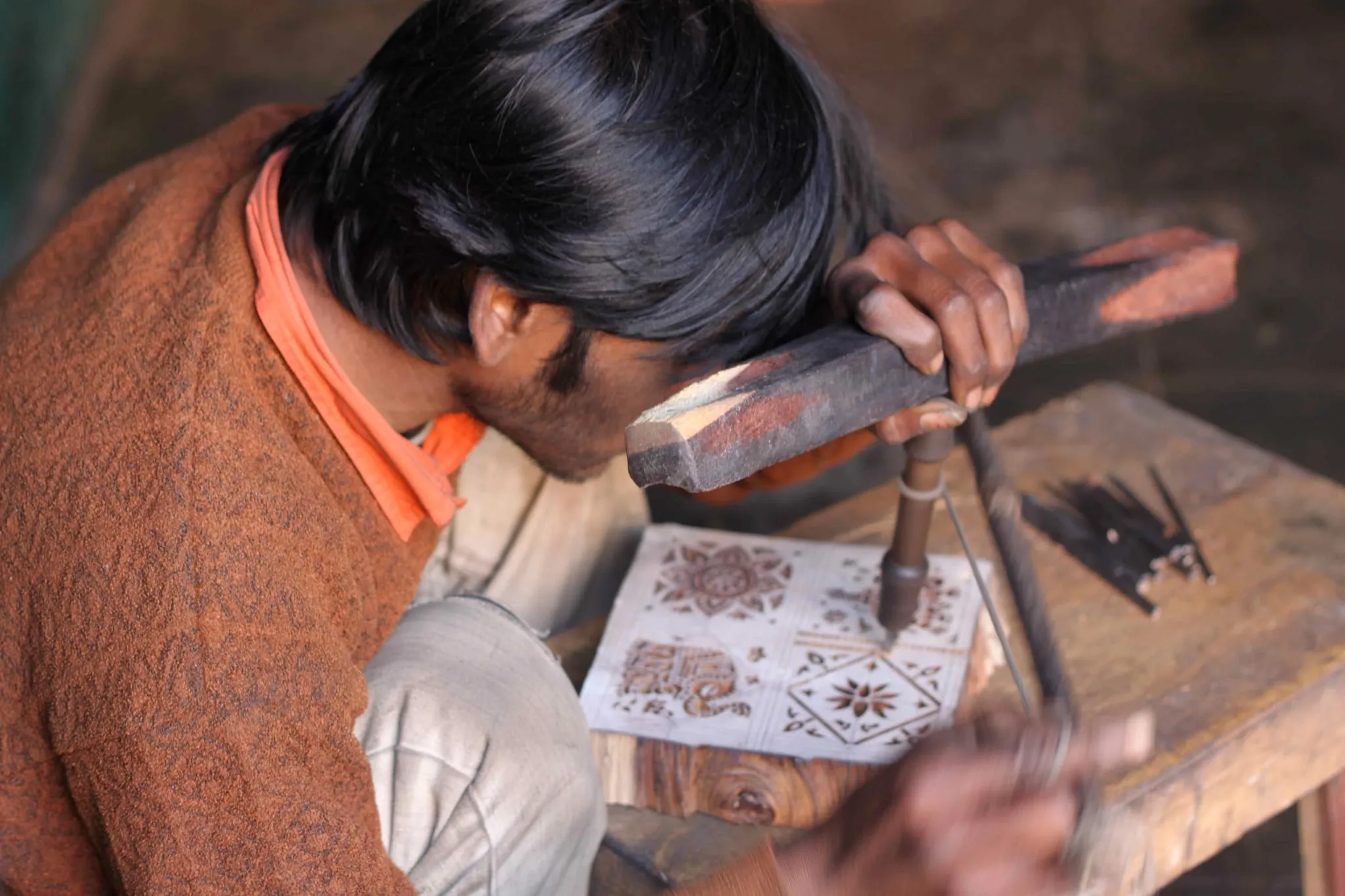
- Block carver · Kharadi
- Carves the design into seasoned hardwood, usually sheesham or teak. A design is normally a set of blocks: the outline, the fill, and the ground. Three to six days for a set.
- Printer · Chhipa
- Prints the cloth by hand at a long padded table, one impression at a time, aligning by eye. Thirty to thirty-five metres of a simple repeat in a day. In Bagru the surname and the verb are the same word.
- Dyer · Rangrez
- Runs the vats and the boiling: indigo, alizarin for red, and the harda bath that prepares the cloth. Some printing houses dye in house; many send cloth to a dyer.
- Washer · Dhobi
- Washes the printed cloth to clear the resist and fix the colour, then spreads it to dry on the ground. The Fields of Colour are the washers’ work.
- Tailor and finisher · Darzi
- Cuts and stitches finished products: totes, robes, cushions, table linen. Calendering, labels and packing sit here too.
- Exporter or courier
- Moves the goods. A workshop with an Import Export Code can ship directly on a commercial invoice; without one, a courier or a merchant exporter does the paperwork.
Histories
The studies-
6th millennium BCE Cotton fibres in a Neolithic grave at Mehrgarh Mehrgarh, Balochistan, Pakistan
Threads preserved by mineralization in a copper bead from a Neolithic burial at Mehrgarh were analysed and identified as cotton (genus Gossypium). The authors could not say whether the cotton came from a domesticated species, but wrote that cotton was already known and exploited for its fibres at this period.
Sources: Harappa.com · Harappa.com
Adapted from The Repeating Hand: A History of Block Printing (CC BY 4.0).
-
c. 4200 BCE (about 6,200-6,000 years ago) World's oldest known indigo-dyed cloth Huaca Prieta, Chicama Valley, north coast of Peru
Cotton fabrics from the Preceramic mound of Huaca Prieta kept traces of a blue pigment that high-performance liquid chromatography identified as indigotin. The oldest indigo-bearing specimen comes from a layer bracketed by radiocarbon-dated strata, and the authors put it at about 6,200 to 6,000 years old. They attribute the dye most likely to Indigofera species native to South America (Splitstoser, Dillehay, Wouters and Claro, Science Advances, 2016).
Sources: Science Advances (AAAS), via PubMed Central · National Geographic
Adapted from Indigo: The Blue That Dyed the World (CC BY 4.0).
-
c. 3300 BCE The earliest textile evidence at Harappa Harappa, Punjab, Pakistan
Excavations at Harappa recovered woven-textile impressions on terracotta beads and spindle whorls from the site's earliest occupations. Harappa.com dates the earliest evidence of textiles there to about 3300 BCE.
Sources: Harappa.com · tDAR (the Digital Archaeological Record): abstract of a paper on Harappan textiles
Adapted from The Repeating Hand: A History of Block Printing (CC BY 4.0).
-
c. 2400 BCE Egypt's earliest indigo-dyed linen Egypt, Old Kingdom (Fifth Dynasty); findspot not named in the sources
Until 2016 the oldest known indigo-dyed textiles were Egyptian linens of the Fifth Dynasty, dated to about 2400 BCE (c. 4,400 years before present). The sources consulted do not name the findspot or say whether the blue came from woad or an Indigofera species. The PROTA plant database notes that both were available to ancient Egyptians.
Sources: Science Advances (AAAS), via PubMed · National Geographic · PROTA (Plant Resources of Tropical Africa), Wageningen / Pl@ntUse
Adapted from Indigo: The Blue That Dyed the World (CC BY 4.0).
-
Urban Harappa period, c. 2600–1900 BCE The Priest-King's carved cloak Mohenjo-daro, Sindh, Pakistan
A steatite bust, 17.5 cm high, found at Mohenjo-daro and now in the National Museum, Karachi. Its left shoulder is covered with a cloak decorated with trefoil, double circle and single circle designs that were originally filled with red pigment, cut with a specialized drill and touched up with a chisel. The carving shows a pattern on a garment; it does not show how that pattern was made on cloth. Harappa.com itself puts the name 'Priest King' in quotation marks.
Sources: Harappa.com, Around the Indus in 90 Slides · Harappa.com, Around the Indus in 90 Slides · Harappa.com, Around the Indus in 90 Slides
Adapted from The Repeating Hand: A History of Block Printing (CC BY 4.0).
-
c. 1915-1745 BCE Anatolia's oldest blue-dyed textile Beycesultan Höyük, Çivril Plain, Denizli Province, Türkiye
A Middle Bronze Age fragment from Beycesultan, dated to about 1915-1745 BCE, is a hemp fabric made by nålbinding (single-needle looping) and dyed with indigo from woad, according to a Koç University team. The results were published in Antiquity (DOI 10.15184/aqy.2024.194). A second hemp fragment of c. 1700-1595 BCE is a plain tabby weave.
Sources: Koç University press release via EurekAlert! (AAAS)
Adapted from Indigo: The Blue That Dyed the World (CC BY 4.0).
-
Reported radiocarbon date 1760 BCE ±115 A scrap of cotton from Mohenjo-daro, reported dyed with madder Mohenjo-daro, Sindh, Pakistan
John Marshall's excavators found a small piece of woven material on the lid of a silver case, preserved by silver salts. The Technological Research laboratory in Bombay found the convoluted structure characteristic of cotton and called its results 'tentative'. The Ashmolean Museum notes that a cotton fragment from Mohenjo-daro, carbon-dated to 1760 BCE ±115, 'has been reported to show evidence of madder dyeing', which would imply knowledge of mordants. Two cautions: the lab report was preliminary, and 1760 BCE is later than the urban Harappa period.
Sources: Harappa.com, quoting John Marshall (1931) · Ashmolean Museum, Eastern Art Online (Yousef Jameel Centre for Islamic and Asian Art)
Adapted from The Repeating Hand: A History of Block Printing (CC BY 4.0).
-
c. 1323 BCE (burial) Indigo and madder on Tutankhamun's linen Tomb of Tutankhamun (KV62), Valley of the Kings, Luxor, Egypt
A 2023 study of a linen fragment from Tutankhamun's tomb, now at the Grand Egyptian Museum's conservation centre, combined gel micro-extraction with reflectance and surface-enhanced Raman spectroscopy. It identified both indigo and madder. The method detects the indigotin molecule, not the plant it came from, so the fragment cannot say whether woad or an Indigofera species was used.
Sources: Gels (MDPI), via PubMed Central
Adapted from Indigo: The Blue That Dyed the World (CC BY 4.0).
-
Bronze and Iron Ages (textiles up to c. 3,500 years old) Woad blues from the Hallstatt salt mines Hallstatt salt mine, Upper Austria
Around 700 prehistoric fabric fragments, mostly wool, survive in the Hallstatt salt mines. Many are striped or checked in blue and other colours. Chromatographic analysis found indigotin, and the Natural History Museum Vienna says woad was the blue dye used in Bronze Age and Hallstatt-period Europe, sometimes applied to cloth after weaving. A 2015 study reported indigotin in 33% of the Bronze Age textiles and 58% of the Iron Age textiles analysed, while cautioning that analysis identifies the dye, not the plant.
Sources: Naturhistorisches Museum Wien (Natural History Museum Vienna) · Naturhistorisches Museum Wien (Natural History Museum Vienna)
Adapted from Indigo: The Blue That Dyed the World (CC BY 4.0).
-
7th century BCE Cuneiform recipes for blue wool Babylonia (southern Mesopotamia); tablet now in the British Museum
A Late Babylonian cuneiform tablet of the seventh century BCE in the British Museum (two joined fragments, BM 62788+82978; registration 1882,0918.2757) records recipes for dyeing wool. Its formulas start with pale- or dark-blue wool (uqnâtu) produced by repeated immersion in a dye bath, then over-dye it with madder to imitate the prestige colours takiltu (blue-purple) and argamannu (red-purple). The tablet does not name the blue dye plant; the chemist Zvi Koren suggests woad. One fragment was published by Erle Leichty in 1979.
Sources: Tradition (Rabbinical Council of America)
Adapted from Indigo: The Blue That Dyed the World (CC BY 4.0).
-
3rd century BCE Xunzi: 'Blue comes from indigo' Warring States China (Xunzi died at Lanling, state of Chu, in present-day Shandong)
The Confucian philosopher Xunzi (c. 300-c. 230 BCE) opens his essay 'Encouraging Learning' (Quan xue) with the line 青,取之於藍而青於藍: blue is taken from the indigo plant (lan) yet is bluer than the plant. The image assumes readers knew that a deeper blue could be extracted from indigo leaves.
Sources: Wikisource (Chinese) · Encyclopaedia Britannica
Adapted from Indigo: The Blue That Dyed the World (CC BY 4.0).
-
Late Preclassic period (roughly the last centuries BCE) Earliest Maya Blue, at Calakmul Calakmul, Campeche, Mexico
Maya Blue is a durable pigment made by binding indigo to the clay mineral palygorskite. Physicochemical analysis identified it on a painted frieze of Late Preclassic date at Calakmul, the earliest known occurrence (Vázquez de Ágredos Pascual, Doménech-Carbó and Doménech-Carbó, Journal of Cultural Heritage, 2011). The year given here is a representative midpoint of the period, not a date for the frieze.
Sources: Open Access Journal of Archaeology & Anthropology (Iris Publishers)
Adapted from Indigo: The Blue That Dyed the World (CC BY 4.0).
-
54 BCE Caesar: Britons stain themselves blue Britain (Cantium, modern Kent, England)
Describing Britain at the time of his second expedition (54 BCE), Julius Caesar wrote in the Gallic War (5.14): 'Omnes vero se Britanni vitro inficiunt, quod caeruleum efficit colorem' (all the Britons stain themselves with vitrum, which produces a blue colour). Vitrum has traditionally been translated as woad, but it usually means glass. Scholars still debate whether a plant dye or a copper- or iron-based pigment was meant, and analyses of the Lindow bog bodies have not settled the question.
Sources: The Latin Library · Encyclopaedia Britannica · Studia Historica. Historia Antigua (Ediciones Universidad de Salamanca)
Adapted from Indigo: The Blue That Dyed the World (CC BY 4.0).
-
mid-1st century CE Indigo shipped from the Indus delta Barbarikon, Indus delta, near modern Karachi, Pakistan (exact site uncertain)
The Periplus of the Erythraean Sea, a Greek merchant's guide to Red Sea and Indian Ocean ports written in the mid-first century CE, lists indigo among the exports of Barbarikon at the mouth of the Indus (section 39). It appears alongside costus, bdellium, nard, turquoise, lapis lazuli, cotton cloth and silk yarn.
Sources: Wikisource · Ashmolean Museum, University of Oxford (Yousef Jameel Centre, Eastern Art Online)
Adapted from Indigo: The Blue That Dyed the World (CC BY 4.0).
-
77 CE Pliny prices Indian indigo at 20 denarii a pound Rome, Italy
In his Natural History (completed 77 CE), Pliny the Elder calls indicum 'a production of India' that looks black as a powder but gives a mix of purple and blue in water. He warns that it was adulterated, including with chalk coloured with woad, and states: 'The price of indicum is twenty denarii per pound.' About a century earlier, Vitruvius (writing after 27 BCE) had noted that painters short of indigo dyed chalk with woad to imitate it.
Sources: Perseus Digital Library, Tufts University · Encyclopaedia Britannica · Project Gutenberg · Encyclopaedia Britannica
Adapted from Indigo: The Blue That Dyed the World (CC BY 4.0).
-
301 CE Diocletian's price edict caps indigo at 750 denarii a pound Roman Empire (copies survive from the eastern provinces); Diocletian's capital Nicomedia shown
Diocletian's Edict on Maximum Prices, issued between 20 November and 10 December 301 CE to check inflation, allows at most 750 denarii for a pound of an item translated as 'Indigo (?)' in its section on drugs, paints and dyes. That is close to the 800 denarii allowed for a pound of pepper. The edict also caps a hide dyed indigo at 400 denarii. The translator marks the identification of the indigo entry as uncertain.
Sources: Antony Kropff (thirdcentury.nl), hosted by the University of Bergen
Adapted from Indigo: The Blue That Dyed the World (CC BY 4.0).
-
c. 544 CE China's step-by-step recipe for indigo paste Northern China (Eastern Wei); author Jia Sixie was from Shouguang, Shandong
Chapter 53, 'Growing indigo', of Jia Sixie's farming manual Qimin yaoshu (completed around 544 CE) gives a full method. In the seventh month the cut plants are steeped under water in a lined pit, then the liquor is moved to jars. Lime is added at 1 dou 5 sheng per 10-shi jar and the mixture is beaten, and the settled sediment is kept as indigo paste (lan dian). The text adds that ten mu of indigo are worth a qing (100 mu) of grain land, and that growers who dye cloth themselves double their profit again.
Sources: Wikisource (Chinese)
Adapted from Indigo: The Blue That Dyed the World (CC BY 4.0).
-
8th century (textiles linked to 752 CE) Knotweed indigo in the Shōsōin treasures Shōsōin repository, Tōdai-ji, Nara, Japan
Non-destructive spectroscopy of 8th-century textiles in the Shōsōin, including a sleeveless coat used in a Buddhist ceremony in 752 CE, distinguished five dyes. Among them was 'ai blue (knotweed)', indigo from the Japanese indigo plant. Most of the repository's contents were dedicated to the Great Buddha of Tōdai-ji by Empress Kōmyō in 756.
Sources: Analytical Chemistry (ACS), via PubMed; Office of the Shosoin Treasure House
Adapted from Indigo: The Blue That Dyed the World (CC BY 4.0).
-
c. 800 CE Charlemagne's estates must supply woad Carolingian royal estates (court at Aachen, Germany)
The Capitulare de villis, Charlemagne's ordinance on running the royal estates, orders stewards to deliver materials for the women's textile workshops. Chapter 43 lists 'linen, wool, woad, vermilion, madder', along with wool combs, teasels and soap. A local-history source dates the text to 795; the Fordham translation gives only the 9th century.
Sources: Fordham University, Internet Medieval Sourcebook · Erfurt-Lese (local history)
Adapted from Indigo: The Blue That Dyed the World (CC BY 4.0).
-
834 CE Woad seeds in the Oseberg ship burial Oseberg mound, Slagen, near Tønsberg, Norway
The Oseberg ship burial, dated by tree rings to 834, contained a box of woad seeds among its grave goods. The Norwegian national encyclopedia takes this as evidence that woad was grown in Viking-age Norway. The grave also held woollen textiles, imported silks and pictorial tapestries.
Sources: Store norske leksikon · Encyclopaedia Britannica
Adapted from Indigo: The Blue That Dyed the World (CC BY 4.0).
-
11 May 868 The Diamond Sutra: the oldest dated printed book Dunhuang, Gansu, China (Mogao cave 17)
A Buddhist text was carved onto woodblocks and printed as a long scroll, with the date 11 May 868. It is printed on paper, not cloth: the best-dated early product of block printing is a book, and this study found no source that settles whether printing on textiles came first.
Sources: Linda Hall Library · Linda Hall Library · Smithsonian Magazine · Smithsonian Magazine
Adapted from The Repeating Hand: A History of Block Printing (CC BY 4.0).
-
9th-10th centuries CE Viking-age dyers at York's Coppergate 16-22 Coppergate, York, England
Excavations at 16-22 Coppergate recovered 1,147 textile-production artefacts together with raw fibres and dyestuffs. Dyeing is well represented in the 9th-10th centuries and fades from the site during the 11th. Plant remains from the site include woad (Isatis tinctoria): an archaeobotanical report on mid-to-late 11th-century deposits says woad pod fragments 'may indicate continued dyeing activity'.
Sources: York Archaeological Trust · Environmental Archaeology Unit, University of York
Adapted from Indigo: The Blue That Dyed the World (CC BY 4.0).
-
10th century A carved wooden textile printing block from Egypt Egypt
The Met holds a carved wooden block catalogued as a textile printing block of the 10th century, from Egypt. It is the tool itself, not a print: a real carved block, a thousand years old.
Sources: The Metropolitan Museum of Art
Adapted from The Repeating Hand: A History of Block Printing (CC BY 4.0).
-
977-978 CE (with letters to c. 1057) Indigo in the Cairo Geniza: Fustat to Qayrawan Qayrawan (Kairouan), Tunisia; goods shipped from Fustat (Old Cairo), Egypt
A Hebrew court record from Qayrawan dated 4738 AM (977-978 CE), preserved in the Cairo Geniza (Cambridge, T-S 12.468), concerns a shipment of indigo sent from Fustat that belonged to a dead merchant. Other Geniza documents include an account headed 'what was sold from the Indian indigo (al-nīl al-hindī)'. A letter of about 1057 complains that merchants from Alexandria were flooding the market with indigo.
Sources: Princeton Geniza Project, Princeton University · Princeton Geniza Project, Princeton University · Princeton Geniza Project, Princeton University
Adapted from Indigo: The Blue That Dyed the World (CC BY 4.0).
-
c. 600-1200 CE (Chichén Itzá's florescence; Maya Blue used c. 300-1500 CE) Maya Blue made in ritual at the Sacred Cenote Sacred Cenote, Chichén Itzá, Yucatán, Mexico
Researchers from Wheaton College and the Field Museum (Antiquity, 2008) concluded that at Chichén Itzá, Maya Blue was made during rituals beside the Sacred Cenote by burning copal incense, palygorskite and probably indigo leaves together. They linked this to the thick layer of blue sediment found when the cenote was dredged in the early 20th century. Their release says Maya Blue was used across Mesoamerica from about 300 to 1500 CE.
Sources: Wheaton College and The Field Museum, via ScienceDaily
Adapted from Indigo: The Blue That Dyed the World (CC BY 4.0).
-
from c. 1010 CE (earliest radiocarbon date) Gujarati indigo-resist cottons reach Egypt Found in Egypt (Fustat and the Red Sea port of Quseir al-Qadim); made in Gujarat, India
The Ashmolean Museum's Newberry collection holds Indian block-printed, resist- and mordant-dyed cottons found in Egypt. Radiocarbon tests in 1994-95 gave dates as early as 1010 CE (plus or minus 55 years), and every blue textile analysed showed traces of indigotin. Designs link the cloths to Gujarat, and 53 Indian textiles were excavated at the Red Sea port of Quseir al-Qadim.
Sources: Ashmolean Museum, University of Oxford (Yousef Jameel Centre, Eastern Art Online)
Adapted from Indigo: The Blue That Dyed the World (CC BY 4.0).
-
11th-12th centuries CE West Africa's oldest indigo textiles Tellem burial caves, Bandiagara Escarpment, Mali
Cotton textiles from Tellem burial caves in the Bandiagara cliff are the oldest known from sub-Saharan Africa. Some date to the 11th or 12th century and already show stripes, checks and tie-dye patterns in indigo from Indigofera or Philenoptera species. The Metropolitan Museum reports that about 500 textiles from 13 cave burial contexts were carbon-14 dated, the earliest to the eleventh century.
Sources: PROTA (Plant Resources of Tropical Africa), Wageningen / Pl@ntUse · PROTA (Plant Resources of Tropical Africa), Wageningen / Pl@ntUse
Adapted from Indigo: The Blue That Dyed the World (CC BY 4.0).
-
c. 1166-1171 CE Benjamin of Tudela's Jewish dyers Jerusalem
The Navarrese traveller Benjamin of Tudela, whose journey his editor dates to between 1166 and 1171, recorded Jewish dyers in southern Italy and the Levant: about ten at Brindisi and one or two at Ludd, Bethlehem, Jaffa and other towns. In Jerusalem he found 'a dyeing-house, for which the Jews pay a small rent annually to the king, on condition that besides the Jews no other dyers be allowed in Jerusalem.' He does not say which dyestuffs they used.
Sources: Project Gutenberg
Adapted from Indigo: The Blue That Dyed the World (CC BY 4.0).
-
1220 onwards (cathedral begun 1220) Woad money builds Amiens Cathedral Amiens Cathedral, Picardy, France
Woad, called waide or guède in Picardy, is recorded in the Somme from 1105, and its trade made Amiens rich. The cathedral's own site says the woad trade 'helped finance a large part of the work' on the building begun in 1220. A sculpture on the south side shows two woad merchants beside a sack of woad.
Sources: Tours et trésor de la cathédrale d'Amiens (official site) · Villes et Pays d'art et d'histoire, Hauts-de-France
Adapted from Indigo: The Blue That Dyed the World (CC BY 4.0).
-
c. 1225 CE Chinese trade official records Gujarat's indigo exports Gujarat, India (described from Quanzhou, China); Cambay/Khambhat shown
Zhao Rugua (Chau Ju-kua), supervisor of maritime trade at Quanzhou, finished his Zhu fan zhi (Records of Foreign Peoples) around 1225. Of Gujarat he wrote that its products 'comprise great quantities of indigo, red kino, myrobolans and foreign cotton stuffs of every colour', and that these goods were shipped every year to the Arab lands (Ta shï) for sale.
Sources: Project Gutenberg
Adapted from Indigo: The Blue That Dyed the World (CC BY 4.0).
-
c. 1293 (voyage of c. 1291-1295; recorded 1298-99) Marco Polo describes indigo-making at Quilon Coilum (Kollam/Quilon), Kerala, India
Marco Polo reported that Coilum had 'abundance of very fine indigo', made by steeping a herb in great vessels of water until it decomposed, then letting the liquid set in the hot sun. The indigo was cut into pieces of four ounces each for export to Europe. He also noted indigo in Gujarat and 'in great abundance' at Cambay. His editor Henry Yule judged that the account 'does describe the chief features of the manufacture of Indigo by fermentation'.
Sources: Project Gutenberg
Adapted from Indigo: The Blue That Dyed the World (CC BY 4.0).
-
13th–14th century Block-printed cottons from India found in Egypt Quseir al-Qadim and Fustat, Egypt
At Quseir al-Qadim, a Red Sea port, 68 cotton fragments were found that match the 'Fustat' textiles identified as Gujarati: resist- and mordant-dyed cottons, mostly block-printed, dyed with indigotin and/or a red colorant from madder or morinda roots. The Quseir find was the first of its kind from a site excavated under datable conditions. Cleveland's catalogue dates a block-printed cotton fragment from Mamluk Egypt to the 1200s–1300s.
Sources: Ashmolean Museum, Eastern Art Online (Yousef Jameel Centre for Islamic and Asian Art) · Ashmolean Museum, Eastern Art Online (Yousef Jameel Centre for Islamic and Asian Art) · The Cleveland Museum of Art
Adapted from The Repeating Hand: A History of Block Printing (CC BY 4.0).
-
14th century Block printing reaches Europe, late Italy and Germany (attribution debated)
The V&A: block printing of textiles 'seems to have come to Europe comparatively late, as there is no evidence that it was practised there earlier than the 14th century'. It may have been introduced into Italy first, then spread into Germany. The museum also notes that little is known about printing or the makers of printed textiles in the 14th century. The marker is approximate.
Sources: Victoria and Albert Museum · Victoria and Albert Museum
Adapted from The Repeating Hand: A History of Block Printing (CC BY 4.0).
-
13th-16th centuries (university opened 1392) Thuringia's woad towns and Erfurt's university Erfurt, Thuringia, Germany
Between the 13th and 16th centuries woad shaped Thuringia's economy more than any other crop. A contiguous growing zone formed between Erfurt, Langensalza, Gotha, Arnstadt and Weimar. Erfurt, with Gotha, Arnstadt, Langensalza and Tennstedt, formed the five Thuringian 'woad towns' that processed and traded the crop. A local history source says woad wealth is 'presumably' what let Erfurt's citizens pay for founding their university, which opened in 1392.
Sources: Erfurt-Lese (local history) · Erfurt-Lese (local history; Anette Huber-Kemmesies)
Adapted from Indigo: The Blue That Dyed the World (CC BY 4.0).
-
15th century A Gujarat cotton with trefoils, found in Cairo Made in Gujarat (probably); found in Cairo
The V&A's fragment IS.73-1972 is printed, mordant and resist-dyed cotton, made in India (Gujarat, probably) in the 15th century and found in Cairo. Its pattern 'consists of geometrical shapes, each filled with a variety of smaller patterns including trefoils', in red and white on an indigo ground.
Sources: Victoria and Albert Museum
Adapted from The Repeating Hand: A History of Block Printing (CC BY 4.0).
-
1463 (start of the 1463-1562 golden age) Toulouse's 'land of cocagne' woad boom begins Toulouse and the Lauragais, Languedoc, France
Toulouse's exports of pastel (woad) grew from the mid-14th century on English demand. The trade's golden age ran from 1463 to 1562. The Lauragais became Europe's leading woad district, nicknamed the 'pays de cocagne' after the cocagnes (balls of crushed woad leaves), and Toulouse became the hub of the trade. Most of the boom falls after 1497.
Sources: Annales du Midi (via Persée) · Haute-Garonne Tourisme (departmental tourism board)
Adapted from Indigo: The Blue That Dyed the World (CC BY 4.0).
-
1498 (traditional founding date) Kano's Kofar Mata dye pits (traditional date) Kofar Mata, old city of Kano, Nigeria
A Google Arts & Culture story by the Centenary Project says the Kofar Mata indigo dye pits in Kano were established in 1498, near the city's central mosque and the historic Kofar Mata gate, and that there are over 100 pits. The date comes from tradition rather than excavation; Wikipedia says only that the pits' origins are commonly traced back more than 500 years. It falls one year after this slice's 1497 cut-off.
Sources: Google Arts & Culture (The Centenary Project / Pan-Atlantic University)
Adapted from Indigo: The Blue That Dyed the World (CC BY 4.0).
-
1498 (traditional date) Kofar Mata dye pits, Kano Kofar Mata, Kano old city, Nigeria
Kano's communal indigo dye pits at Kofar Mata are traditionally dated to 1498. More than 100 pits survive, and cloth dyed there was sold along trans-Saharan and Sahelian routes. The date comes from local tradition and the sign at the site. No contemporary document confirming it has been found.
Sources: Google Arts & Culture / Pan-Atlantic University (The Centenary Project)
Adapted from Indigo: The Blue That Dyed the World (CC BY 4.0).
-
20 May 1498 Vasco da Gama reaches Calicut: Europe gets a direct sea route to Indian dyestuffs Calicut (Kozhikode), Malabar Coast, India
Vasco da Gama's fleet reached Calicut on 20 May 1498 and returned to Lisbon in 1499, opening a direct Portuguese sea route that bypassed Venetian and Levantine middlemen. No surviving invoice proves indigo was in the first cargoes, which were dominated by spices; but by 1516 Duarte Barbosa's price list for Calicut quoted 'good indigo', and later in the century Lodovico Guicciardini listed anil among the East Indian goods Antwerp received from Portugal.
Sources: Encyclopaedia Britannica · Project Gutenberg (digitized text) · Project Gutenberg (digitized text)
Adapted from Indigo: The Blue That Dyed the World (CC BY 4.0).
-
15th–16th century A carved printing block from India India
The Met's carved wooden printing block from India, 15th–16th century, shows the tool behind the Gujarati cottons that reached Egypt. The Met records it only as 'India', so the marker on the map is approximate.
Sources: The Metropolitan Museum of Art
Adapted from The Repeating Hand: A History of Block Printing (CC BY 4.0).
-
1555–1562 (boom peak); crisis from c. 1561 Toulouse's 'Pays de Cocagne' woad fortune peaks, then breaks Toulouse (Hôtel d'Assézat), Lauragais woad triangle Albi–Toulouse–Carcassonne, France
From the Middle Ages to the 16th century woad (pastel), sold as dried balls called cocagnes, made the Albi–Carcassonne–Toulouse triangle rich; a French heritage inventory cites exports of up to 200,000 bales of about 100 kg from Bordeaux in the 16th century. Pastel merchant Pierre d'Assézat built his Toulouse mansion between 1555 and 1562. The trade then entered crisis: the standard monograph (Caster) ends its study in 1561, and local accounts point to poor harvests (1560–61), the Wars of Religion from 1562, and growing competition from imported indigo. In the 17th century dyers began adding tropical indigo to woad vats.
Sources: Ministère de la Culture (France), Inventaire du patrimoine culturel immatériel · Ministère de la Culture (France), Inventaire du patrimoine culturel immatériel · Mairie de Toulouse (À Toulouse magazine) · Institut national universitaire Champollion (student heritage project blog)
Adapted from Indigo: The Blue That Dyed the World (CC BY 4.0).
-
9 November 1577 Imperial police ordinance bans the 'Teuffelsfarb' (devil's dye), which was vitriol, not yet indigo Frankfurt am Main (Reichsdeputationstag), Holy Roman Empire
The Reichspolizeiordnung of 9 November 1577, drawn up at the Imperial Deputation Diet in Frankfurt, banned a 'newly invented, harmful, deceitful, corrosive' cloth dye 'called the Teuffelsfarb', explaining that dyers used vitriol and other cheap corrosive materials instead of woad. The text does not name indigo. Johann Beckmann (18th century) reports the ban was renewed in 1594 and 1603; only later legislation (Saxony 1650, the Empire 1654) extended the 'devil's dye' label to indigo.
Sources: Transcription of the original Early New High German text (ra.smixx.de); critical edition: M. Weber, Die Reichspolizeiordnungen von 1530, 1548 und 1577 (MPI) · Transcription of the original Early New High German text (ra.smixx.de) · Project Gutenberg (digitized text)
Adapted from Indigo: The Blue That Dyed the World (CC BY 4.0).
-
1549; 15 May 1581 Crown tries to keep Indigenous workers out of indigo works, and turns to enslaved Africans Santiago de Guatemala (Antigua Guatemala), seat of the Audiencia
A 1549 order for the Audiencia of Guatemala barred hiring Indigenous people in textile and sugar mills, and repeated royal orders extended the ban to indigo obrajes, whose fermentation vats were notoriously deadly. A 1581 order (AGCA A1.23, leg. 1513, f. 565) stated the need to use enslaved people of African descent in indigo making because 'there are no black workers' and Indigenous people were being called in. Enforcement was weak: obraje owners continued to use Indigenous labour and paid fines and bribes.
Sources: Análise Social (Instituto de Ciências Sociais, Universidade de Lisboa) · Análise Social (Instituto de Ciências Sociais, Universidade de Lisboa) · Horacio Cabezas Carcache (self-published PDF with AGI transcription)
Adapted from Indigo: The Blue That Dyed the World (CC BY 4.0).
-
1581 (23 Eliz. I c. 9) England's Elizabethan dye act targets logwood, and names woad-and-indigo as a lawful ground Westminster (Parliament of England), London
The 1580/81 'act for the abolishing of certain deceitful stuff used in the dyeing of cloths' banned logwood ('blockwood'), not indigo; a 1597 bill outlawed the logwood trade and Charles II's parliament legalised logwood again from 1 February 1661. Beckmann notes that the 1581 statute is the first mention of indigo in English law, requiring woollens dyed black to be first grounded blue 'by woad, or woad and indigo together'. Later claims (e.g., Andrew Ure, cited by Beckmann's 1846 editors) that Elizabeth banned indigo appear to conflate it with the logwood ban.
Sources: Itinerario (Cambridge University Press, open access) · Project Gutenberg (digitized text)
Adapted from Indigo: The Blue That Dyed the World (CC BY 4.0).
-
1598 (and repeated); the '1609 death penalty' edict is unverified France forbids indigo at the request of the Estates of Languedoc Languedoc woad country (Toulouse), France
According to Johann Beckmann, 'in consequence of an urgent representation by the states of that province' (Languedoc), the use of indigo was forbidden in France in 1598, and the prohibition was repeated several times. Many popular and some institutional sources (including a BnF Gallica blog) state that Henri IV banned indigo on pain of death, usually dated 1609; no primary text of such an edict was located in this research, and Beckmann's detailed account does not mention it.
Sources: Project Gutenberg (digitized text)
Adapted from Indigo: The Blue That Dyed the World (CC BY 4.0).
-
1572–1600 Xiquilite obrajes spread along Central America's Pacific slope Province of San Salvador, Audiencia de Guatemala (modern El Salvador)
Indigo from the native Indigofera suffruticosa (xiquilite/jiquilite) was being shipped from the jurisdiction of San Salvador to Spain via Puerto Caballos (Honduras) by 1572. A count for 1600 lists about 200 indigo works (obrajes) in El Salvador, 40 in Escuintepeque, 60 in Guazapán and 60 more in San Miguel, Tecpanatitlán, Choluteca and Nicaragua, roughly 360 in all. Beckmann, writing in the 18th century, states that the first American indigo to reach Europe came from 'Guatimala'.
Sources: Museo Nacional de Arqueología y Etnología, Guatemala / Asociación Tikal (via Mesoweb) · Análise Social (Instituto de Ciências Sociais, Universidade de Lisboa) · Project Gutenberg (digitized text)
Adapted from Indigo: The Blue That Dyed the World (CC BY 4.0).
-
30 April 1624 Ten captive Angolans sold in Guatemala for 85 quintals of indigo Santiago de Guatemala (Antigua Guatemala)
In the first half of the 17th century añil served as a medium of exchange in the Kingdom of Guatemala: slaves, houses, dowries and even tithe farms were priced in quintals of indigo. On 30 April 1624 Captain Duarte Gómez de Chávez sold ten newly arrived enslaved Africans from Angola to Sancho de Carranza y Medinilla for 85 quintals of coastal indigo, about 8.5 quintals per person, payable at Christmas 1625 and 1626. In 1621 the tithe of San Miguel and Choluteca was sold for 45 quintals of indigo.
Sources: Horacio Cabezas Carcache (self-published PDF with AGI transcription) · Horacio Cabezas Carcache (self-published PDF with AGI transcription)
Adapted from Indigo: The Blue That Dyed the World (CC BY 4.0).
-
1626 Dutch and English companies fight over Bayana indigo near Agra Bayana, Agra region (Mughal India; modern Rajasthan)
In the early 17th century the Dutch (VOC) and English (EIC) East India companies bought indigo in two main Mughal markets: Sarkhej near Ahmedabad in Gujarat and Bayana near Agra, whose indigo was then prized as the best. In 1626 the VOC factor at Agra, Francisco Pelsaert, complained that Armenian merchants were 'running and racing about like hungry folk' in the indigo districts and driving up prices. Armenian buyers carried indigo overland to Persia, undercutting the Europeans' attempts at monopoly.
Sources: Éditions de la Maison des sciences de l'homme / OpenEdition Books · World History Encyclopedia
Adapted from Indigo: The Blue That Dyed the World (CC BY 4.0).
-
1631 Seven VOC ships land 333,545 lb of Gujarat and Bayana indigo Dutch Republic (VOC return fleet; Amsterdam used as reference point)
Beckmann lists the indigo aboard seven ships arriving in Holland from the East Indies in 1631: 13,539 lb of 'Sirches' (Sarkhej) indigo, 82,734 and 66,996 lb of 'Guzerat' indigo, 50,795 lb of 'Bajano' and 59,698 lb of 'Bejana' (Bayana) indigo, and 32,251 and 27,532 lb of 'Chirches' (Sarkhej), 333,545 lb in total, valued at 500,000 dollars. In April 1633 three ships brought 4,092 'kartel' of indigo worth 2,046,000 rix-dollars. German writers of the time blamed the Dutch for bringing indigo into Germany.
Sources: Project Gutenberg (digitized text) · Project Gutenberg (digitized text)
Adapted from Indigo: The Blue That Dyed the World (CC BY 4.0).
-
26 June – 4 July 1636 Guatemala's president bans Indigenous labor in indigo works, for one week Santiago de Guatemala (Antigua Guatemala)
On 26 June 1636 President Álvaro de Quiñones Osorio of the Audiencia of Guatemala issued Autos forbidding the use of Indigenous people in indigo obrajes, citing whole villages on the Pacific coast (including Tecoluca and Zacatecoluca in San Salvador) emptied by obraje labor, and took sworn testimony from clergy and officials. On 4 July 1636 the Real Acuerdo suspended the ban, arguing that royal revenues and convents financed by indigo would suffer. The year before, he had ordered non-Indians out of Indian towns and founded the villa of San Vicente de Austria (Lorenzana).
Sources: Horacio Cabezas Carcache (self-published PDF with AGI transcription) · Horacio Cabezas Carcache (self-published PDF with AGI transcription)
Adapted from Indigo: The Blue That Dyed the World (CC BY 4.0).
-
1650 (Saxony); 21 April 1654 (Empire) Saxony and the Holy Roman Empire outlaw indigo as a 'devil's dye' Holy Roman Empire (imperial prohibition of Ferdinand III; Diet then sitting at Regensburg)
Beckmann records that the first prohibition aimed specifically at indigo was issued by Saxony in 1650, worded so that indigo fell under the old 'devil's dye' label. In 1652 Duke Ernest the Pious of Saxe-Gotha (a woad state) proposed to the Imperial Diet that indigo be banished from the Empire, and an imperial prohibition followed on 21 April 1654 against smuggled indigo. Nuremberg required its dyers to swear an annual oath not to use indigo, an oath Beckmann says they were still taking in his day.
Sources: Project Gutenberg (digitized text) · Project Gutenberg (digitized text) · Project Gutenberg (digitized text)
Adapted from Indigo: The Blue That Dyed the World (CC BY 4.0).
-
August 1669; Instruction générale 1671; liberalised 1737 Colbert's dye regulations admit indigo into French 'grand et bon teint' dyeing Paris, France
Colbert's 1669 regulations split French dyers into 'fine' (grand et bon teint) and 'common' trades and, according to Beckmann, regulated the use of indigo alongside woad; the 1671 Instruction générale then standardised thirteen permitted shades of blue. In 1737 dyers were left free to use indigo alone or mixed with woad. By the mid-18th century French blue dyeing ran on imported Antillean indigo, chiefly from Saint-Domingue.
Sources: Project Gutenberg (digitized text) · ISTE OpenScience, Technologie et Innovation
Adapted from Indigo: The Blue That Dyed the World (CC BY 4.0).
-
23 September 1670 Jamaica counts 49 indigo works alongside 57 sugar works Jamaica (return compiled by the Receiver-General; Spanish Town was the capital)
A 1670 return of Jamaica's commodities, signed by Receiver-General Thomas Tothill, counted 57 sugar works producing 1,710 thousand weight of sugar, 47 cocoa walks, and '49 indigo works, producing 49,000 weight of indigo per annum', about 1,000 lb per works. English Caribbean planters in Barbados, Antigua and Jamaica experimented with indigo before concentrating on sugar.
Sources: British History Online (Calendar of State Papers Colonial, America and West Indies, vol. 7) · Charleston County Public Library (Charleston Time Machine)
Adapted from Indigo: The Blue That Dyed the World (CC BY 4.0).
-
1690–1700 Indian imports start European calico printing England or the Netherlands
A V&A printed calico of 1690–1700, probably made in England or the Netherlands, comes with this account: Indian painted textiles imported by the Dutch, English and French East India Companies gave a direct incentive to make satisfactory substitutes at home, and this led to the development of European calico printing industries. Giorgio Riello adds that Europeans found it hard to replicate mordant-based printing and dyeing.
Sources: Victoria and Albert Museum · London School of Economics, Global Economic History Network (working paper by Giorgio Riello)
Adapted from The Repeating Hand: A History of Block Printing (CC BY 4.0).
-
1700s Awa (Tokushima) sukumo takes over Japan's market Yoshino River plain, Tokushima (Awa province), Japan
Tokushima's indigo is sold as sukumo, composted leaf of the Japanese indigo plant. Its output grew from the Edo into the Meiji period and led the national market in the 1700s. The prefecture credits cotton growing around Osaka, protection by the Tokushima domain, and local soil and climate.
Sources: Tokushima Prefectural Government
Adapted from Indigo: The Blue That Dyed the World (CC BY 4.0).
-
from 1694 (observed); published 1722 Père Labat describes and illustrates the French Caribbean indigoterie Macouba parish, Martinique (Labat's parish)
The Dominican Jean-Baptiste Labat, in the French Antilles from 1694, published his Nouveau voyage aux isles de l'Amérique in 1722; its engraving of indigo manufacture shows the three-vat works (trempoire or steeping vat, batterie or beating vat, and diablotin/reposoir) worked by enslaved Africans. Archaeology at L'Anse à la Barque in Guadeloupe shows indigo works built from the 17th century and abandoned in the 18th as Saint-Domingue overtook Guadeloupe; John Garrigus notes that Labat, visiting Saint-Domingue's south coast in 1701, treated indigo (like tobacco) as a crop that let planters accumulate capital for sugar works.
Sources: Slavery Images: A Visual Record of the African Slave Trade and Slave Life in the Early African Diaspora (slaveryimages.org) · Colonial Williamsburg Foundation (Slavery and Remembrance) · The Americas (Cambridge University Press)
Adapted from Indigo: The Blue That Dyed the World (CC BY 4.0).
-
1739–1744 Eliza Lucas's indigo trials at Wappoo produce a marketable dye Wappoo plantation, Wappoo Creek, near Charleston, South Carolina (approximate)
Left in charge of the family's Wappoo plantation when her father returned to Antigua in 1739, Eliza Lucas experimented with West Indian indigo seed; George Lucas sent Nicolas Cromwell, a dye maker from Montserrat, to build an indigo works, and in the fifth year of trials the plantation produced its own seed and a dye good enough to market. Six pounds of dye were sent to England, where a broker judged it as good as 'some of the best french'. Historians stress she was one of several experimenters (with Andrew Deveaux and others) and that enslaved people did the labor.
Sources: South Carolina Encyclopedia (University of South Carolina, Institute for Southern Studies) · South Carolina Encyclopedia (University of South Carolina, Institute for Southern Studies) · Charleston County Public Library (Charleston Time Machine)
Adapted from Indigo: The Blue That Dyed the World (CC BY 4.0).
-
May 1744 bounty; 1747 first large exports Carolina's own bounty and wartime shortages launch indigo exports: 138,300 lb in 1747 Charleston (Charles Town), South Carolina
In May 1744 the South Carolina legislature offered a bounty of one shilling (South Carolina currency) per pound on several new export crops including indigo, and cancelled it for indigo in April 1746 because output had grown so fast. King George's War (1739–48) had raised rice freight and insurance costs and cut Britain off from French West Indian indigo. Large-scale exports began in 1747, when 138,300 lb worth £16,803 sterling were shipped to England.
Sources: Charleston County Public Library (Charleston Time Machine) · Charleston County Public Library (Charleston Time Machine) · South Carolina Encyclopedia (University of South Carolina, Institute for Southern Studies) · U.S. Bureau of the Census (digitized by Federal Reserve Bank of St. Louis, FRASER)
Adapted from Indigo: The Blue That Dyed the World (CC BY 4.0).
-
1748 (21 Geo. II c. 30); payable from 1749 Parliament pays sixpence a pound for British-colonial indigo Westminster (Parliament of Great Britain), London
Lobbied by South Carolina merchant and agent James Crokatt, Parliament in 1748 enacted a bounty, initially six pence sterling per pound, paid to British importers of American colonial indigo; it took effect in 1749. Indigo was already an 'enumerated' commodity that had to be shipped to Britain under the 1660 act, and nearly all Carolina indigo went there. The bounty was renewed by later continuance acts and lapsed in 1777 during the Revolution.
Sources: Charleston County Public Library (Charleston Time Machine) · U.S. Bureau of the Census (digitized by Federal Reserve Bank of St. Louis, FRASER) · South Carolina Encyclopedia (University of South Carolina, Institute for Southern Studies)
Adapted from Indigo: The Blue That Dyed the World (CC BY 4.0).
-
1747–1775 Enslaved 'indigo makers' carry Carolina's dye industry South Carolina Lowcountry (Charleston area)
Planting, weeding, harvesting and the skilled steeping-and-beating that turned leaves into dye in South Carolina were done almost entirely by enslaved people of African descent; skilled 'indigo slaves' were valued because a year's crop depended on the indigo maker's judgment. Charles Woodmason estimated in 1755 that 50 acres needed 15 hands to grow and 25 'very able' hands to process, at about 50 lb of dye per acre. Whether Africans brought indigo expertise from West Africa is plausible but poorly documented for Carolina; a Louisiana parish museum credits enslaved West African dyers there.
Sources: South Carolina Encyclopedia (University of South Carolina, Institute for Southern Studies) · Charleston County Public Library (Charleston Time Machine) · Charleston County Public Library (Charleston Time Machine)
Adapted from Indigo: The Blue That Dyed the World (CC BY 4.0).
-
1755–1772 Georgia joins the indigo trade: 4,500 lb in 1755, peak 22,300 lb in 1770 Savannah, Georgia
Georgia began exporting indigo in the 1750s, shipping 4,500 lb in 1755; its exports peaked at 22,300 lb in 1770. Georgia remained a minor producer next to South Carolina, whose exports in 1770 were 550,800 lb. Colonial-era indigo plantations operated on Georgia's barrier islands, such as the North End Plantation on Ossabaw Island.
Sources: New Georgia Encyclopedia (Georgia Humanities / University of Georgia Press) · U.S. Bureau of the Census (digitized by Federal Reserve Bank of St. Louis, FRASER)
Adapted from Indigo: The Blue That Dyed the World (CC BY 4.0).
-
1759 France lifts its ban on printed cottons France
Riello writes that calico printing spread from Basle to Mulhouse and Neuchâtel and 'from there back to France after the ban was lifted in 1759'. This study did not find the 1686 French ban's own text, so the start of the prohibition is not stated here.
Sources: London School of Economics, Global Economic History Network (working paper by Giorgio Riello) · London School of Economics, Global Economic History Network (working paper by Giorgio Riello)
Adapted from The Repeating Hand: A History of Block Printing (CC BY 4.0).
-
15 February 1765 (EIC order); mid-18th century Indigo-dyed Indian 'blue goods' buy captives on the West African coast East India House, London (order to Fort William, Calcutta, for African-market cloth)
Indian cotton cloth dyed with indigo, 'blue goods' in English, 'guinée' in French, and types such as bafts, nicanees and 'guinea stuffs', was a key currency for buying enslaved people from African brokers. In Anglo-African trade, Indian piece goods made up about 30% of total export value in the mid-18th century, and on 15 February 1765 the English East India Company asked Fort William to send more textiles to London for African markets. In the Senegal River region Indian cloth became a regional currency in the late 18th century, and S. M. X. Golberry, visiting West Africa in the 1780s, noted that the smell of indigo authenticated blue cloth as currency.
Sources: London School of Economics, South Asia@LSE blog · London School of Economics, South Asia@LSE blog · Dutch Textile Trade project (eds. Carrie Anderson & Marsely Kehoe)
Adapted from Indigo: The Blue That Dyed the World (CC BY 4.0).
-
1768–1777 East Florida's indigo colony at New Smyrna New Smyrna (Smyrnéa), British East Florida
After Britain acquired Florida in 1763, indigo became East Florida's main export crop, worked largely by more than 9,000 enslaved Black laborers brought by planters from the Carolinas and Georgia. Scottish physician Andrew Turnbull recruited 1,403 Minorcan, Greek and Italian indentured colonists, who sailed from Gibraltar in April 1768 to grow indigo at New Smyrna; the colony collapsed in 1777 amid disease, drought and abuse. HSUS notes British Florida produced only 20,000–60,000 lb a year in the last five colonial years.
Sources: Museum of Florida History (Florida Department of State) · Volusia County Government · U.S. Bureau of the Census (digitized by Federal Reserve Bank of St. Louis, FRASER)
Adapted from Indigo: The Blue That Dyed the World (CC BY 4.0).
-
1771–1772 Saint-Domingue's indigo exports top 4 million livres Saint-Domingue (French colony, modern Haiti)
Saint-Domingue dominated 18th-century European indigo supply. Marguerite Martin's research on French trade finds production/exports rising above 4 million livres (French pounds) in 1771–1772, falling after the American war to about 1.46 million livres at the end of the Ancien Régime, close to peacetime levels of about 1.3 million a year in 1730–35 and the 1750s. In 1784–86, 1.55 million livres of indigo a year reached France from the French American islands, 98% from Saint-Domingue.
Sources: Institut de la gestion publique et du développement économique (IGPDE) / OpenEdition Books · Institut de la gestion publique et du développement économique (IGPDE) / OpenEdition Books
Adapted from Indigo: The Blue That Dyed the World (CC BY 4.0).
-
1775 Carolina indigo exports peak at 1,122,200 lb Charleston (Charles Town), South Carolina
South Carolina's recorded indigo exports peaked at 1,122,200 lb in 1775, valued at £242,395 sterling (about 4s 4d per lb). Note that the Historical Statistics series flags the 1775 figure as covering 6½ months ending 24 February, so it is not a normal calendar-year total. Indigo was the colony's second export after rice and, per the South Carolina Encyclopedia, the fifth most valuable export of Britain's mainland colonies.
Sources: South Carolina Encyclopedia (University of South Carolina, Institute for Southern Studies) · U.S. Bureau of the Census (digitized by Federal Reserve Bank of St. Louis, FRASER)
Adapted from Indigo: The Blue That Dyed the World (CC BY 4.0).
-
May 1775 Mouzon's map of the Carolinas puts indigo-making in its cartouche London (published by Robert Sayer and John Bennett)
Henry Mouzon's 'An Accurate Map of North and South Carolina with Their Indian Frontiers' was first published in London in May 1775 by Sayer and Bennett. Its lower-left cartouche shows indigo plants and enslaved people working an indigo plantation and processing the dye, echoing Mouzon's 1773 map of St. Stephen's Parish. Copies used by Revolutionary War commanders, including Rochambeau, survive at the Library of Congress, the American Geographical Society and the Clements Library.
Sources: South Carolina Historical Society · Charleston County Public Library (Charleston Time Machine)
Adapted from Indigo: The Blue That Dyed the World (CC BY 4.0).
-
c. 1777-1790s East India Company shifts Indian indigo to Bengal Lower Bengal (Chandernagore/Hooghly area), India
After Gujarat's export trade had been lost to American colonial producers, the East India Company organised experiments to revive Indian indigo in Bengal. Production was at first a Company monopoly; Company servants then set up their own factories, whose output was for some years sold compulsorily to the Company and used for remittances home. Tradition names a Frenchman, Louis Bonnaud, as Bengal's first European planter (c. 1777) near Chandernagore, but that attribution rests on secondary sources.
Sources: Imperial Gazetteer of India (Clarendon Press, 1908), via Digital South Asia Library, University of Chicago · Imperial Gazetteer of India (Clarendon Press, 1908), via Digital South Asia Library, University of Chicago · Georgia Institute of Technology (SMARTech repository)
Adapted from Indigo: The Blue That Dyed the World (CC BY 4.0).
-
1775–1777 Revolution cuts Carolina indigo off from Britain; the bounty lapses Charleston (Charles Town), South Carolina
The Continental Congress prohibited exports to Britain (rice excepted until summer 1777), so Carolina producers tried northern and French Caribbean buyers with limited success, and the parliamentary bounty created in 1748 expired in 1777. Exports recovered partially after 1783 (Charleston alone shipped 974,100 lb in 1787 by HSUS; the South Carolina Encyclopedia gives 907,258 lb) but declined sharply in the 1790s as Britain turned to Bengal and planters moved to cotton; by 1802 indigo no longer appeared among the state's exports.
Sources: Charleston County Public Library (Charleston Time Machine) · South Carolina Encyclopedia (University of South Carolina, Institute for Southern Studies) · U.S. Bureau of the Census (digitized by Federal Reserve Bank of St. Louis, FRASER)
Adapted from Indigo: The Blue That Dyed the World (CC BY 4.0).
-
1778–1785 Guatemala City merchants handle 60% of Central American indigo Nueva Guatemala de la Asunción (Guatemala City)
Troy Floyd, using Spanish sales-tax (alcabala) accounts, gives Central American indigo production of 1,089,636 lb in 1778 and finds that 21 Guatemala City merchants exported almost 2,500,000 lb in 1778–1785, about 60% of total production. Indigo, gathered at fairs such as Apastepeque in San Salvador, was shipped by mule (one zurrón of about 212 lb per mule) and barge to the Caribbean port of Santo Tomás for Cádiz. The indigo fair was moved to San Salvador in 1787.
Sources: Business History Review (Cambridge University Press) · Business History Review (Cambridge University Press)
Adapted from Indigo: The Blue That Dyed the World (CC BY 4.0).
-
1782 Growers' fund (Montepío de cosecheros de añil) founded at San Vicente San Vicente (de Austria), Alcaldía Mayor of San Salvador
To break Guatemala City merchants' grip on credit and prices, Bourbon authorities under Matías de Gálvez founded a Sociedad y Montepío de cosecheros de añil in 1782, based at San Vicente, to advance credit to indigo growers, and moved the indigo fair from Guatemala City to San Vicente. Around this period about 90% of the Kingdom of Guatemala's harvest came from the province of San Salvador. Local conflicts followed, such as the 1783–84 dispute over hoarding of indigo seed ('mostazas') in Zacatecoluca.
Sources: Trashumante. Revista Americana de Historia Social (Universidad de Antioquia), via Redalyc · Trashumante. Revista Americana de Historia Social (Universidad de Antioquia), via Redalyc
Adapted from Indigo: The Blue That Dyed the World (CC BY 4.0).
-
c. 1783 A printshop at Jouy-en-Josas Jouy-en-Josas, France
Riello cites a printed vignette of a printshop in Jouy-en-Josas belonging to the calico printer Oberkampf in the early 1780s. The Met holds the printed cloth 'Les Travaux de la Manufacture', dated 1783: a textile that shows the works that made it.
Sources: London School of Economics, Global Economic History Network (working paper by Giorgio Riello) · The Metropolitan Museum of Art
Adapted from The Repeating Hand: A History of Block Printing (CC BY 4.0).
-
1786 First Bengal indigo shipments reach England: 266,000 lb Bengal (East India Company territories) → London
England imported 266,000 lb of indigo from Bengal in 1786, as the East India Company and newly arrived British planters began producing indigo there with West Indian methods. Bengal's exports to England grew especially from 1794, from about 1.4 million lb to 7.25 million lb by 1815. R. C. Nash argues Carolina never held a monopoly of the British market; wartime prize indigo captured from France and Spain also supplied Britain.
Sources: Institut de la gestion publique et du développement économique (IGPDE) / OpenEdition Books · Institut de la gestion publique et du développement économique (IGPDE) / OpenEdition Books · Economic History Review (via RePEc/IDEAS abstract)
Adapted from Indigo: The Blue That Dyed the World (CC BY 4.0).
-
c. 1789 (state of the colony at 18 October 1789) Saint-Domingue counts 3,150 indigoteries, and free people of color own many Saint-Domingue (French colony, modern Haiti)
Moreau de Saint-Méry's description of French Saint-Domingue as of 1789 counts 793 sugar works, 3,150 indigo works (indigoteries) and 3,117 coffee plantations; the Western Province alone had 1,804 indigoteries. Indigo's low capital needs made it a route to planter status for free people of color, especially in the southern peninsula; an indigo planter from the southern peninsula led their campaign for civil reform during the French Revolution. In older districts such as Arcahaye, indigo works (186 in 1752) gave way to sugar after irrigation.
Sources: Internet Archive (digitized book) · The Americas (Cambridge University Press)
Adapted from Indigo: The Blue That Dyed the World (CC BY 4.0).
-
1793–1795 Caterpillar plague ends Louisiana indigo; planters turn to sugar West Baton Rouge / lower Mississippi, Spanish Louisiana
French Louisiana received indigo seed in the 1720s and indigo remained an export crop under Spanish rule, with plantations still appearing in West Baton Rouge in the late 1780s and 1790s. A caterpillar plague destroyed the crop in 1793; after Étienne de Boré's successful sugar granulation near New Orleans in 1795, planters shifted to sugar cane. The West Baton Rouge Museum credits enslaved West African indigo farmers and dyers with establishing the local industry.
Sources: West Baton Rouge Museum (West Baton Rouge Parish) · New Georgia Encyclopedia
Adapted from Indigo: The Blue That Dyed the World (CC BY 4.0).
-
1816–18 Stamped adinkra cloth reaches the British Museum Kumase, Asante Empire (modern Ghana)
A British Art Studies article describes adinkra as a stamped textile, made of cotton woven in long strips and decorated with repeated patterns in a grid. Thomas Bowdich acquired objects including stamped adinkra cloth on an 1816–18 mission centred on an 1817 journey to Kumase, and presented them to the British Museum in 1818 (formally added in 1831).
Sources: British Art Studies (Yale Center for British Art and Paul Mellon Centre), issue 28 · British Art Studies (Yale Center for British Art and Paul Mellon Centre), issue 28
Adapted from The Repeating Hand: A History of Block Printing (CC BY 4.0).
-
1825-26 Bengal indigo output reaches 156,548 factory maunds Bengal and Bihar (shipped via Calcutta), India
A series compiled in 1832 by John Phipps of the Calcutta Master Attendant's office puts output in Bengal and adjoining territories at 62,500 maunds in 1795-96, falling to 23,800 in 1798-99, then rising to 114,481 in 1815-16 and a peak of 156,548 maunds in 1825-26 (about 5,300 tonnes at 33.868 kg per maund). The series swings widely from year to year: 79,678 maunds in 1826-27, then 151,699 in 1827-28.
Sources: Munich Personal RePEc Archive (MPRA paper 100408)
Adapted from Indigo: The Blue That Dyed the World (CC BY 4.0).
-
1830-1859 Advances, debt and violence: the ryoti system in Lower Bengal Nadia, Jessore and Barasat districts, Bengal
Planters got almost all their indigo from peasant cultivators (ryots), who took a yearly cash advance and contracted to sow part of their land. The advance rarely covered costs, so debts piled up and passed down through families. Planters also cultivated some land directly (nij). In July 1860 the magistrate Ashley Eden told the Indigo Commission the cultivation was 'always compulsory' and submitted an abstract of 49 serious cases (murder, riot, arson, dacoity, plunder, kidnapping) from 1830 to 1859.
Sources: Georgia Institute of Technology (SMARTech repository) · Georgia Institute of Technology (SMARTech repository) · Internet Archive (Columbia University Libraries microform) · Internet Archive (Columbia University Libraries microform)
Adapted from Indigo: The Blue That Dyed the World (CC BY 4.0).
-
January 1851 Barth describes a Hausa dyeing-place at Tasawa Tasawa (Tessaoua), Niger
On the road to Kano in January 1851, Heinrich Barth described the dyeing-place (marina) at Tasawa: a raised clay platform with 14 pits of indigo mixture, in which cloth stayed from one to seven days depending on the shade wanted.
Sources: Internet Archive (Getty Research Institute copy)
Adapted from Indigo: The Blue That Dyed the World (CC BY 4.0).
-
February-March 1851 Barth measures Kano's indigo-cloth economy Kano, Nigeria
Barth reported that Kano's main commerce was cotton cloth woven and dyed in the city and nearby towns, including dark-blue women's turkedi and the black litham (rawani baki). He estimated exports to Timbuktu alone at 300 camel-loads a year worth 60,000,000 kurdi (cowries), and all cloth sold abroad at no less than 300,000,000 kurdi, at a time when a family could live on 50,000-60,000 kurdi (GBP 4-5) a year. The emir levied 700 kurdi on each of the 'more than two thousand' dyeing pots in the town.
Sources: Internet Archive (Getty Research Institute copy) · Internet Archive (Getty Research Institute copy) · Internet Archive (Getty Research Institute copy)
Adapted from Indigo: The Blue That Dyed the World (CC BY 4.0).
-
19th century - present Kano cloth for the Tuareg 'Blue People' Central Sahara (Air/Agadez); cloth dyed in Kano
Barth listed the black (indigo) litham or face-veil cloth, rawani baki, among Kano's main exports. He noted that the Tawarek (Tuareg) prized the blue-and-white 'Guinea-fowl' shirt above all other kinds. Tuareg men's indigo veils and turbans, which can stain the skin, gave rise to the name 'Blue People of the Sahara'.
Sources: Internet Archive (Getty Research Institute copy) · Internet Archive (Getty Research Institute copy) · Fowler Museum at UCLA
Adapted from Indigo: The Blue That Dyed the World (CC BY 4.0).
-
March 1859 - 1860 Indigo Revolt (Nil Bidroho) begins in Nadia Nadia district, Bengal (now West Bengal, India / Bangladesh)
In March 1859 the ryots of a village in Nadia district agreed to stop growing indigo. The strike spread to the other indigo districts of Lower Bengal, including Jessore. Planters had pushed or forced ryots to sign contracts to grow indigo instead of food crops on their best land, and paid them less than rice would have earned.
Sources: Encyclopaedia Britannica · Imperial Gazetteer of India (Clarendon Press, 1908), via Digital South Asia Library, University of Chicago
Adapted from Indigo: The Blue That Dyed the World (CC BY 4.0).
-
31 March - August 1860 Act XI of 1860 and the Indigo Commission Calcutta, Bengal Presidency
A bill read for the third time on 31 March 1860 (Act XI of 1860) enforced that season's indigo contracts by summary process and set up a commission of enquiry. The commission, chaired by W. S. Seton-Karr, took evidence in Calcutta through mid-1860. Its August report was highly critical of the planters and affirmed that ryots could not be forced to grow indigo.
Sources: Internet Archive (digitized Government of India publication) · Encyclopaedia Britannica · Internet Archive (Columbia University Libraries microform)
Adapted from Indigo: The Blue That Dyed the World (CC BY 4.0).
-
1860 (English translation 1861) Dinabandhu Mitra's play Nil Darpan Dacca (Dhaka), Bengal
Dinabandhu Mitra's Bengali play Nil Darpan ('The Indigo Planting Mirror') was written in 1858-59 and published in 1860. An anonymous English translation ('by a Native', usually attributed to Michael Madhusudan Dutt) was printed in Calcutta in 1861. Its introduction describes a peasant proprietor forced by the indigo system to take advances until he became 'a serf and a vagabond'.
Sources: Encyclopaedia Britannica · Project Gutenberg (eBook #54027, from Internet Archive scans)
Adapted from Indigo: The Blue That Dyed the World (CC BY 4.0).
-
July 1861 Rev. James Long convicted of libel for publishing Nil Darpan Supreme Court, Calcutta
The Anglican missionary James Long had the English translation of Nil Darpan printed and circulated. Planters' interests prosecuted him for libel in July 1861. He was convicted, sentenced to one month in jail and fined Rs 1,000. The Bengali writer Kaliprasanna Singha paid the fine at once.
Sources: Scroll.in
Adapted from Indigo: The Blue That Dyed the World (CC BY 4.0).
-
1865 Adolf von Baeyer begins his indigo research Gewerbe-Akademie (Trade Academy), Klosterstraße, Berlin, Prussia
Adolf von Baeyer, a lecturer in organic chemistry at Berlin's Gewerbe-Akademie since 1860, began working on indigo in 1865. The work led to his identification of indole and to a partial synthesis of indigotin; in 1870, with A. Emmerling, he reduced isatin to indigo. It was the first step in a 15-year academic–industrial effort to make the dye from coal-tar chemicals.
Sources: Nobel Prize Outreach / NobelPrize.org · Chemie in unserer Zeit (VCH), vol. 31 no. 3, English reprint by BASF, hosted by ACIT
Adapted from Indigo: The Blue That Dyed the World (CC BY 4.0).
-
1860s-1868 Indigo moves to Bihar; tinkathia fixed at 3 kathas per bigha Tirhut (Champaran, Saran, Muzaffarpur, Darbhanga), Bihar
After the Bengal revolt the industry moved from Lower Bengal to Bihar and the United Provinces. In Bihar most indigo was grown under the asamiwar contract: at first peasants had to plant 6 kathas of every bigha. After peasant agitation in 1867-68 the government cut this to 3 kathas, which became the tinkathia system. From the 1860s planters also bought up peasants' private land for direct (nij or zirat) cultivation.
Sources: Imperial Gazetteer of India (Clarendon Press, 1908), via Digital South Asia Library, University of Chicago · Georgia Institute of Technology (SMARTech repository)
Adapted from Indigo: The Blue That Dyed the World (CC BY 4.0).
-
20 May 1873 Riveted work pants patented, the birth of blue jeans Levi Strauss & Co., Battery Street, San Francisco, California (inventor Jacob W. Davis, Reno, Nevada)
US Letters Patent No. 139,121, 'Improvement in Fastening Pocket-Openings', dated 20 May 1873 (filed 9 August 1872), was issued to Reno tailor Jacob W. Davis as assignor to himself and Levi Strauss & Co. of San Francisco; it claims trousers whose pocket openings are secured with rivets. Levi Strauss & Co. began making copper-riveted 'waist overalls' from 'XX' denim. In 1890 the company first assigned lot numbers, designating the riveted waist overall '501', and the rivet patent passed into the public domain.
Sources: United States Patent and Trademark Office · Levi Strauss & Co. · Levi Strauss & Co.
Adapted from Indigo: The Blue That Dyed the World (CC BY 4.0).
-
1878–1882 Baeyer's laboratory syntheses of indigo Chemical Laboratory, University of Munich, Bavaria
In 1878 Baeyer completed the first laboratory synthesis of indigo (from phenylacetic acid via oxindole and isatin). Between 1880 and 1882 he found two further routes, from cinnamic acid via o-nitrophenylpropiolic acid, and (with Viggo Drewsen) from o-nitrobenzaldehyde and acetone. The 1880 patent was assigned to BASF for 100,000 marks and later extended to Hoechst; BASF sold o-nitrophenylpropiolic acid as 'little indigo' for printing from April 1881, but none of these routes could supply bulk indigo because raw materials such as toluene were scarce (4 t of toluene per tonne of indigo).
Sources: Chemie in unserer Zeit (VCH), vol. 31 no. 3, English reprint by BASF, hosted by ACIT · Chemie in unserer Zeit (VCH), vol. 31 no. 3, English reprint by BASF, hosted by ACIT · Chemie in unserer Zeit (VCH), vol. 31 no. 3, English reprint by BASF, hosted by ACIT · Nobel Prize Outreach / NobelPrize.org
Adapted from Indigo: The Blue That Dyed the World (CC BY 4.0).
-
3 August 1883 Baeyer sends BASF the structural formula of indigo University of Munich, Bavaria (letter to Heinrich Caro at BASF, Ludwigshafen)
In a letter dated 3 August 1883 to his friend Heinrich Caro, head of BASF's research laboratories, Baeyer set out the structural formula of indigo in the middle of an account of family matters. The letter survives in the Deutsches Museum in Munich (letter no. 207). Knowing the structure let chemists search systematically for cheaper routes to the indoxyl intermediate.
Sources: Chemie in unserer Zeit (VCH), vol. 31 no. 3, English reprint by BASF, hosted by ACIT
Adapted from Indigo: The Blue That Dyed the World (CC BY 4.0).
-
1883 Morris revives indigo discharge and the hand block Merton Abbey, Surrey, England
William Morris designed 'Strawberry Thief' in 1883 (V&A) and printed it with the indigo discharge method, 'an ancient technique used for many centuries mostly in Asia'. Cleveland's record says the process required the entire cloth to be dyed blue before it was bleached and block printed.
Sources: Victoria and Albert Museum · The Cleveland Museum of Art
Adapted from The Repeating Hand: A History of Block Printing (CC BY 4.0).
-
1890–1891 Heumann's aniline and anthranilic-acid routes; BASF's mercury-catalysed naphthalene oxidation Eidgenössisches Polytechnikum (ETH), Zurich, Switzerland
In 1890 Zurich professor Karl Heumann published two routes in which phenylglycine (from aniline) or phenylglycine-o-carboxylic acid (from anthranilic acid) is fused with caustic alkali to give indoxyl, which oxidizes in air to indigo; BASF and Hoechst bought the patents. The aniline route gave at most about 10% yield, so BASF pursued the anthranilic-acid route, which needed a cheap way to oxidize naphthalene to phthalic acid. According to BASF's own history, in 1891 a laboratory assistant broke a mercury thermometer during an oleum oxidation and chemist E. Sapper deduced that mercury had catalysed the reaction.
Sources: Chemie in unserer Zeit (VCH), vol. 31 no. 3, English reprint by BASF, hosted by ACIT · Chemie in unserer Zeit (VCH), vol. 31 no. 3, English reprint by BASF, hosted by ACIT · Chemie in unserer Zeit (VCH), vol. 31 no. 3, English reprint by BASF, hosted by ACIT · BASF SE (corporate history)
Adapted from Indigo: The Blue That Dyed the World (CC BY 4.0).
-
1894-96 Peak of Indian indigo: about 1.7 million acres, record exports British India (Bihar, Madras, United Provinces, Punjab)
The official agricultural returns put British India's indigo area at 1,705,977 acres in 1894-95, the highest in the series. The crop forecast for that year estimated a yield of about 237,500 cwt. Exports hit a record 187,337 cwt worth Rs 5.35 crore (about GBP 3.57 million) in 1895-96. Bihar and the rest of Bengal Presidency shipped 109,000 cwt of the 1896-97 total and Madras 44,000 cwt.
Sources: Internet Archive (digitized Government of India publication) · Internet Archive (digitized Government of India publication) · Internet Archive (digitized Government of India publication) · Internet Archive (digitized Government of India publication) · Imperial Gazetteer of India (Clarendon Press, 1908), via Digital South Asia Library, University of Chicago
Adapted from Indigo: The Blue That Dyed the World (CC BY 4.0).
-
10 July 1897 BASF launches synthetic 'Indigo rein' (Indigo Pure BASF) BASF works, Ludwigshafen am Rhein, Germany
BASF's new indigo complex (5.4 ha, 34 furnaces, capacity 2,000 t a year) started large-scale production in February 1897, and the first 'Indigo Pure BASF' went on sale on 10 July 1897 at 16 marks/kg. BASF says the project took 17 years and about 18 million gold marks, more than the company's share capital at the time. Competitors accused BASF of selling purified plant indigo, so the company commissioned an independent report from Berlin chemist Otto N. Witt, dated 29 June 1898 ('Gutachten über Indigo rein B.A.S.F.').
Sources: Chemie in unserer Zeit (VCH), vol. 31 no. 3, English reprint by BASF, hosted by ACIT · Chemie in unserer Zeit (VCH), vol. 31 no. 3, English reprint by BASF, hosted by ACIT · BASF SE (corporate history) · TEXtalks (DyStar Ludwigshafen feature)
Adapted from Indigo: The Blue That Dyed the World (CC BY 4.0).
-
1897-1900 Synthetic indigo reaches the market; Bihar planters turn to research Bihar (Tirhut) indigo districts
BASF's synthetic indigo went on sale in 1897, and its price fell from 3.40 marks/kg in 1897 to 2.10 in 1903 (BASF archives, cited by Kumar). From 1897 planters' associations, with government help, paid for chemical, bacteriological and agricultural research on indigo. In 1900 Nature warned that if synthetic indigo drove out the natural dye it would hit 'the wealth of India'.
Sources: Imperial Gazetteer of India (Clarendon Press, 1908), via Digital South Asia Library, University of Chicago · Nature (via Internet Archive) · Georgia Institute of Technology (SMARTech repository)
Adapted from Indigo: The Blue That Dyed the World (CC BY 4.0).
-
1901-1903 Indigo factory workforce falls from 173,000 to 82,000 British India (chiefly Bihar)
Not counting small vats, India had 923 indigo factories employing 173,000 people in 1901, and only 531 employing 82,000 in 1903. The Imperial Gazetteer estimated that losing the industry altogether would take away part-year work from 250,000 people. The indigo area, which had averaged 2,000 square miles in the ten years to 1899-1900, was 1,100 square miles by 1903-04.
Sources: Imperial Gazetteer of India (Clarendon Press, 1908), via Digital South Asia Library, University of Chicago · Imperial Gazetteer of India (Clarendon Press, 1908), via Digital South Asia Library, University of Chicago
Adapted from Indigo: The Blue That Dyed the World (CC BY 4.0).
-
13 August 1901 Pfleger's sodamide process; Hoechst becomes the second producer Degussa, Gutleutstraße, Frankfurt am Main, Germany
Johannes Pfleger of Degussa found that adding sodamide to the alkaline melt made Heumann's cheap aniline-based phenylglycine route give high yields; his US patent 680,395 (13 August 1901) was assigned to Degussa. Hoechst took the patent and set up an 'Indigo Company' with Degussa. It stopped work on an almost finished plant at Gersthofen and converted its Höchst works to the sodamide process for 11 million marks, producing 300 t in 1902 and 800 t in 1903. In the Heumann–Pfleger process, phenylglycine is made from aniline, formaldehyde and hydrogen cyanide (a step BASF adopted in 1925). It remains the standard industrial route today.
Sources: United States Patent and Trademark Office · United States Patent and Trademark Office · Chemie in unserer Zeit (VCH), vol. 31 no. 3, English reprint by BASF, hosted by ACIT · Chemie in unserer Zeit (VCH), vol. 31 no. 3, English reprint by BASF, hosted by ACIT
Adapted from Indigo: The Blue That Dyed the World (CC BY 4.0).
-
1 April 1903 Japan raises its tariff on Indian indigo Japan (import market for Bengal indigo)
From 1 April 1903 Japan raised the duty on Indian indigo from 12.953 to 21.422 yen per picul. India had not acceded to the Anglo-Japanese treaty, so other producers, and German synthetic indigo, kept the lower conventional rate. Indian officials reported a 'noticeable falling off' in the Japan trade, especially in Bengal indigo.
Sources: Internet Archive (digitized Government of India publication)
Adapted from Indigo: The Blue That Dyed the World (CC BY 4.0).
-
1903 Japan's Awa-ai indigo peaks, then collapses Yoshino River basin (Aizumi area), Tokushima Prefecture, Japan
Tokushima's 'Awa ai' is sukumo, a dye made by composting (fermenting) dried leaves of Polygonum tinctorium. Cultivation there peaked at about 15,000 hectares in 1903. After that, imports of precipitated indigo from India and synthetic indigo from Europe caused production to fall sharply. Tokushima still makes most of Japan's sukumo.
Sources: Tokushima Prefectural Government · Tokushima Prefectural Government
Adapted from Indigo: The Blue That Dyed the World (CC BY 4.0).
-
1903 (Meiji 36) Tokushima indigo area peaks at about 15,000 ha, then collapses Tokushima Prefecture, Japan
Tokushima's indigo area peaked at about 15,000 hectares in 1903. Imports of precipitated indigo from India and synthetic indigo from Europe then undercut it: 7,542 ha in 1907, 502 ha in 1926 and 4 ha in 1965.
Sources: Tokushima Prefectural Government · Tokushima Prefectural Government · Shikoku University (Tokushima)
Adapted from Indigo: The Blue That Dyed the World (CC BY 4.0).
-
10 December 1905 Baeyer wins the Nobel Prize in Chemistry Munich University (laureate's affiliation); prize presented in Stockholm
The 1905 Nobel Prize in Chemistry went to Adolf von Baeyer of Munich University 'in recognition of his services in the advancement of organic chemistry and the chemical industry, through his work on organic dyes and hydroaromatic compounds'. The presentation speech of 10 December 1905 highlighted his indigo syntheses. It noted that indigo's price had already fallen to a third and that Germany's 1904 exports of synthetic indigo were worth more than 25 million marks.
Sources: Nobel Prize Outreach / NobelPrize.org · Nobel Prize Outreach / NobelPrize.org
Adapted from Indigo: The Blue That Dyed the World (CC BY 4.0).
-
April 1905 Cone's White Oak denim mill opens in Greensboro White Oak plant, Cone Mills, Greensboro, North Carolina, USA
Moses and Ceasar Cone's White Oak plant began operating in April 1905 and grew into what Textile World calls the largest denim plant in the world. Levi Strauss & Co. began buying Cone denim early in the century and bought exclusively from Cone from 1922. In 1927 Cone developed the 10 oz red-selvage 'XX' denim, woven on 29-inch looms, for the 501.
Sources: Textile World · Levi Strauss & Co. · Levi Strauss & Co.
Adapted from Indigo: The Blue That Dyed the World (CC BY 4.0).
-
1905-06 Indian indigo exports fall 83% in ten years Calcutta and Madras ports, India
India exported only 31,186 cwt of indigo worth Rs 58.63 lakh in 1905-06, against 187,337 cwt and Rs 535.45 lakh in 1895-96: an 83.26% fall in quantity and 89.05% in value. The average price fell from Rs 285.8 to Rs 188 per cwt. The trade review for 1904-05 called the figures 'a melancholy record of the decline of an old and important industry'.
Sources: Internet Archive (digitized Government of India publication) · Internet Archive (digitized Government of India publication)
Adapted from Indigo: The Blue That Dyed the World (CC BY 4.0).
-
1906 Sodium dithionite ('hydrosulfite') becomes the standard indigo reducing agent BASF works, Ludwigshafen am Rhein, Germany
In 1906 BASF marketed sodium dithionite (Na2S2O4) as 'Hydrosulfite Conc. BASF'. Because it is a stable solid and a strong reducer, it replaced fermentation vats and earlier arsenic, iron(II)-sulfate and zinc vats as the standard way to reduce indigo to soluble leuco-indigo. It is still the dominant reducing agent. Its breakdown products, sulfite and sulfate, are the main chemical load in denim-mill wastewater.
Sources: Chemie in unserer Zeit (VCH), vol. 31 no. 3, English reprint by BASF, hosted by ACIT · Nature Chemical Biology 14:256–261 (author manuscript on PubMed Central) · Chemical & Engineering News (American Chemical Society)
Adapted from Indigo: The Blue That Dyed the World (CC BY 4.0).
-
c. 1910-1930s Yoruba adire: from Abeokuta tie-dye to hand-painted adire eleko Abeokuta and Ibadan, Nigeria
Adire, indigo resist-dyed cloth made by Yoruba women, first appeared as a distinct type in Abeokuta. Adire eleko, with designs painted in cassava starch before dyeing, is dated to no earlier than about 1910 and grew popular in the 1920s on imported European cotton shirting. Ibadan became the centre for hand-painted cloths. Popular designs included Olokun ('goddess of the sea') and the Jubilee pattern made for George V's 1935 jubilee. Buyers came from Nigeria, the Gold Coast, Senegal and the Belgian Congo.
Sources: Horniman Museum and Gardens · Victoria and Albert Museum · Cambridge University Press (Journal of African History 38:1, pp. 77-99)
Adapted from Indigo: The Blue That Dyed the World (CC BY 4.0).
-
1913 German synthetic indigo reaches its pre-war peak BASF, Ludwigshafen (also Hoechst, Frankfurt-Höchst), Germany
BASF made 4,900 t of indigo in 1913 by three parallel processes, its highest output ever; Hoechst made 4,500 t by the sodamide process. Together they exported 10,000 t of synthetic indigo worth 53.3 million marks. In 1897 Germany had imported 12.7 million marks' worth of natural indigo. Prices had fallen from 16 marks/kg at launch to 7 marks/kg in 1904 because of price competition between BASF and Hoechst, then held at about 8 marks/kg under an 'indigo convention'. Refined natural indigo cost 20 marks/kg in 1897.
Sources: Chemie in unserer Zeit (VCH), vol. 31 no. 3, English reprint by BASF, hosted by ACIT · Chemie in unserer Zeit (VCH), vol. 31 no. 3, English reprint by BASF, hosted by ACIT · Chemie in unserer Zeit (VCH), vol. 31 no. 3, English reprint by BASF, hosted by ACIT · Chemie in unserer Zeit (VCH), vol. 31 no. 3, English reprint by BASF, hosted by ACIT
Adapted from Indigo: The Blue That Dyed the World (CC BY 4.0).
-
1895–1914 India's natural indigo industry collapses Tirhut indigo districts (Champaran, Saran, Muzaffarpur, Darbhanga), Bihar, British India
Indian indigo exports fell from 187,337 cwt in 1895–96 to 49,252 cwt in 1904–05, and the average export value fell from Rs 285.82 to Rs 169.46 per cwt. Nature reported in 1918 that the area under indigo, nearly 1,700,000 acres in 1895, had shrunk to under 150,000 acres, and that the London price had fallen from 7s–8s per lb in 1897 to 3s in early 1914. By then manufacture had practically ceased everywhere except Bihar. In Bihar's four indigo districts the area fell from 135,769 ha (1894–95) to 9,872 ha (1914–15).
Sources: Georgia Institute of Technology (PhD dissertation, History of Technology) · Nature (vol. 101, pp. 388–389) · Nature (vol. 101, pp. 388–389) · Chemie in unserer Zeit (VCH), vol. 31 no. 3, English reprint by BASF, hosted by ACIT
Adapted from Indigo: The Blue That Dyed the World (CC BY 4.0).
-
1915-1918 First World War revival: indigo area jumps to 765,000 acres British India (Madras, United Provinces, Bihar, Punjab)
When German synthetic supplies stopped, the indigo area rose from 146,000 acres (1914-15) to 351,000 (1915-16) and 765,000 (1916-17). An Indigo Conference met at Delhi on 22 February 1915. Exports rose to 41,932 cwt worth GBP 1.39 million in 1915-16, and estimated production to 95,700 cwt in 1916-17. The revival was led by Madras (60% of the 1916-17 area), not Bihar.
Sources: Internet Archive (digitized Government of India publication) · Internet Archive (digitized Government of India publication) · Internet Archive (digitized Government of India publication) · Internet Archive (digitized Government of India publication)
Adapted from Indigo: The Blue That Dyed the World (CC BY 4.0).
-
1914–1918 War blockade briefly revives Indian indigo; Britain starts its own synthesis Champaran district (Motihari), Bihar, British India
The Allied naval blockade cut off German exports, and German indigo output fell to zero by 1918. India's indigo area recovered to 300,000 ha by 1916 (Schmidt), or over 750,000 acres in 1916–17 (UF/IFAS), with Madras (344,300 acres) now well ahead of Bihar and Orissa (76,000 acres). Peasant grievances over forced indigo growing in Champaran led to Gandhi's Champaran Satyagraha in 1917. Also in 1917, the Levinstein family made Britain's first synthetic indigo at the seized Hoechst (MLB) works at Ellesmere Port. After the war Swiss, US, Japanese and British firms began producing indigo, and the natural revival ended.
Sources: Chemie in unserer Zeit (VCH), vol. 31 no. 3, English reprint by BASF, hosted by ACIT · Chemie in unserer Zeit (VCH), vol. 31 no. 3, English reprint by BASF, hosted by ACIT · University of Florida IFAS Extension (EDIS publication ENH1378/EP642) · Georgia Institute of Technology (PhD dissertation, History of Technology) · Georgia Institute of Technology (PhD dissertation, History of Technology)
Adapted from Indigo: The Blue That Dyed the World (CC BY 4.0).
-
April - October 1917 Gandhi's Champaran Satyagraha against tinkathia Motihari, Champaran district, Bihar
At the request of the cultivator Rajkumar Shukla, Gandhi went to Champaran in April 1917 to investigate indigo tenants' complaints. Under tinkathia a tenant had to plant 3 of every 20 parts of his land with indigo for the landlord. Charged under Section 144, Gandhi appeared in Motihari court on 18 April 1917 with about 2,000 people outside. The case was withdrawn, and volunteers took nearly 4,000 statements in a month. A government inquiry committee with Gandhi as a member reported on 4 October 1917.
Sources: Press Information Bureau, Government of India · Press Information Bureau, Government of India · Press Information Bureau, Government of India · Mahatma Gandhi (Navajivan Trust text hosted by mkgandhi.org, Bombay Sarvodaya Mandal)
Adapted from Indigo: The Blue That Dyed the World (CC BY 4.0).
-
4 March 1918 Champaran Agrarian Act abolishes tinkathia Bihar and Orissa Legislative Council; applied in Champaran district, Bihar
On the committee's recommendations the government abolished tinkathia. Planters had to refund part of the payments the committee found unlawful. The Champaran Agrarian Act passed the Bihar and Orissa Legislative Council on 4 March 1918.
Sources: Press Information Bureau, Government of India · Mahatma Gandhi (Navajivan Trust text hosted by mkgandhi.org, Bombay Sarvodaya Mandal)
Adapted from Indigo: The Blue That Dyed the World (CC BY 4.0).
-
1921-22 Japan becomes India's largest indigo customer Japan (from Indian ports)
India exported 12,400 cwt of indigo in 1921-22, mainly to Japan (7,200 cwt), Egypt (2,000), Persia (1,400) and the United Kingdom (600). Japan's purchases then fell from 2,189 cwt in 1923-24 to 647 cwt in 1924-25, during a price war between German and American synthetic dyes in Japan.
Sources: Internet Archive (digitized Government of India publication) · Internet Archive (digitized Government of India publication)
Adapted from Indigo: The Blue That Dyed the World (CC BY 4.0).
-
1923-1925 After the war: area down to 107,000 acres, exports 3,300 cwt British India
Once German and American synthetic dyes returned, the indigo area fell to 107,000 acres in 1924-25 and estimated output to 19,100 cwt. Exports were 3,300 cwt worth Rs 11 lakh, less than half the 1923-24 figure. The export cess that had funded indigo research was abolished from 1 August 1923.
Sources: Internet Archive (digitized Government of India publication) · Internet Archive (digitized Government of India publication) · Internet Archive (digitized Government of India publication)
Adapted from Indigo: The Blue That Dyed the World (CC BY 4.0).
-
1930s (collapse 1937-39) Adire crisis: caustic soda, synthetic indigo and the Alake's ban Abeokuta, Nigeria
In the Depression, newcomers used synthetic indigo and caustic soda, which led to quality complaints and a collapse in demand for adire. In the 1930s Alake Ademola of Abeokuta banned caustic soda and synthetic dye, and the women dyers hired lawyers and petitioned colonial officials. Byfield dates the collapse of the industry to 1937-39.
Sources: WATJCentre (watjcentre.org), presentation by Judith A. Byfield
Adapted from Indigo: The Blue That Dyed the World (CC BY 4.0).
-
1940s–1965 Blue jeans go global and indigo has a renaissance Levi Strauss & Co. headquarters, San Francisco, California
According to Levi's timeline, US soldiers carried Levi's jeans overseas in the Second World War, which was the product's first international exposure. The company began exporting to Europe in 1959 and set up Levi Strauss International and Levi Strauss Far East in 1965 (Levi Strauss Japan followed in 1971). BASF dates indigo's renaissance to the mid-1960s, 'when blue jeans become a cult item for an entire generation'. BASF made 800–1,600 t of indigo a year from the 1950s to the late 1970s, and at the end of 1967 decided to rebuild its war-damaged plant rather than abandon production.
Sources: Levi Strauss & Co. · Levi Strauss & Co. · BASF SE (corporate history) · Chemie in unserer Zeit (VCH), vol. 31 no. 3, English reprint by BASF, hosted by ACIT
Adapted from Indigo: The Blue That Dyed the World (CC BY 4.0).
-
1970–1973 Japan begins making its own denim (Kurabo KD-8; Kaihara rope dyeing) Kurabo, Kurashiki, Okayama Prefecture, Japan (Kaihara at Fukuyama, Hiroshima)
Until about 1970, jeans and denim fabric in Japan came only from American imports. Kurabo started Japan's first denim business in 1970 and in 1973 began selling Japan's first domestic denim fabric, KD-8, spun on its own denim-yarn machinery. Kaihara, a Fukuyama indigo-kasuri weaver founded in 1893, says it built Japan's first rope-dyeing machine in 1970 and became a denim maker in 1973.
Sources: Kurabo Industries Ltd. · Kurabo Industries Ltd. · The Mills Fabrica (Kaihara company profile)
Adapted from Indigo: The Blue That Dyed the World (CC BY 4.0).
-
14 October 1983 Bacteria engineered to make indigo Amgen, Thousand Oaks, California, USA
Ensley and colleagues reported in Science (14 Oct 1983) that E. coli carrying naphthalene-oxidation genes from a Pseudomonas putida plasmid (NAH7) turns blue by making indigo from indole. In 1993 an Amgen team (Murdock et al.) built strains that make indigo directly from glucose using at least nine cloned genes. Genencor later refined a glucose fermentation for 'biotech indigo' (Berry et al., 2002). None of these displaced the aniline route. A 2023 review notes that glucose still costs about three times as much as aniline.
Sources: Science (abstract via NCBI PubMed E-utilities) · Bio/Technology (abstract via NCBI PubMed E-utilities) · Journal of Industrial Microbiology & Biotechnology (abstract via NCBI PubMed E-utilities) · Bioresources and Bioprocessing 10:20 (open access, via Europe PMC full-text API)
Adapted from Indigo: The Blue That Dyed the World (CC BY 4.0).
-
1998 Pre-reduced liquid indigo cuts hydrosulfite use DyStar indigo plant (former BASF works), Ludwigshafen, Germany
DyStar says it introduced the first pre-reduced 'DyStar Indigo Vat 40% Solution' in 1998. A 2023 review dates the first pre-reduced indigo products to 1993. Suppliers reduce indigo by catalytic hydrogenation and ship the leuco-indigo solution under nitrogen, so dye houses need little or no sodium hydrosulfite. DyStar tests cited in the literature found about a ninefold drop in sulphite in dye-house wastewater (27,084 to 3,250 mg/L).
Sources: TEXtalks (DyStar Ludwigshafen feature) · Chemical & Engineering News (American Chemical Society) · Bioresources and Bioprocessing 10:20 (open access, via Europe PMC full-text API) · Bioresources and Bioprocessing 10:20 (open access, via Europe PMC full-text API)
Adapted from Indigo: The Blue That Dyed the World (CC BY 4.0).
-
19 June 2000 US imposes anti-dumping duties on Chinese synthetic indigo US Department of Commerce, Washington, DC
After a 1999 petition by Buffalo Color Corporation (a US indigo producer) and the United Steelworkers, the US Commerce Department issued an anti-dumping order on synthetic indigo ('Vat Blue 1', including pre-reduced forms) from China, effective 19 June 2000. Duty margins were 79.70% for named exporters, including Wonderful Chemical Industrial Ltd./Jiangsu Taifeng Chemical Industry Co., and 129.60% for all other PRC exporters. The order was revoked in May 2006 after the US International Trade Commission's five-year review.
Sources: Federal Register vol. 65 no. 118 (US Department of Commerce, International Trade Administration) · Federal Register (US Department of Commerce) via FederalRegister.gov API
Adapted from Indigo: The Blue That Dyed the World (CC BY 4.0).
-
2006; 2024 report Miao batik of Danzhai granted national heritage status Danzhai County, Guizhou, China
Miao women in Danzhai make batik with beeswax and indigo. The craft received national heritage status in 2006. The provincial government reported in 2024 that more than 200 Miao women from nearby villages benefited and that annual sales had reached 8 million yuan (about USD 1.1 million).
Sources: Guizhou Provincial Government (eGuizhou English portal)
Adapted from Indigo: The Blue That Dyed the World (CC BY 4.0).
-
Ming-Qing; listed 2006 Nantong blue calico listed as national intangible heritage Nantong, Jiangsu, China
Nantong was a cotton-textile centre in the Ming (1368-1644) and Qing (1644-1911) dynasties, when its resist-printed blue calico sold across China. Local records list 19 registered hand-dyeing workshops. The dye comes from fermented indigo plants. The printing and dyeing technique was listed as national intangible cultural heritage in 2006.
Sources: Nantong Municipal People's Government (English portal)
Adapted from Indigo: The Blue That Dyed the World (CC BY 4.0).
-
26 July 2006 Sakon Nakhon natural indigo fabric registered as a Geographical Indication Sakon Nakhon, Isan, Thailand
'Sakon Nakhon Natural Indigo Fabric', cotton dyed with natural indigo using locally inherited methods, was registered as a Thai Geographical Indication on 26 July 2006. In 2026 the fabric was chosen for Thai athletes' ceremony outfits at the Asian Games.
Sources: Thairath English
Adapted from Indigo: The Blue That Dyed the World (CC BY 4.0).
-
27 August 2007 Blue wastewater from jeans laundries in Tehuacán, Mexico Tehuacán, Puebla, Mexico
Al Jazeera reported that Tehuacán, once known for its water, had become a centre of jeans production. Untreated water tinted blue by chemicals and dyes from jeans-washing plants flowed into rivers and irrigation channels. Farmers reported crop and soil damage from the contaminated water.
Sources: Al Jazeera English
Adapted from Indigo: The Blue That Dyed the World (CC BY 4.0).
-
November 2008 Living Blue revives indigo farming in northern Bangladesh Rajendrapur, Rangpur Sadar, Rangpur, Bangladesh
In 2006 a CARE project in Rangpur identified a local plant ('malkhari') as indigo. Farmer training followed, and in November 2008 Nijera Cottage and Village Industries began trading under the brand 'Living Blue', which became Living Blue Pvt. Ltd. in 2014 (51% CARE, 49% artisans and farmers). By 2022 about 550 farmers and 240 artisans were involved. The enterprise reports about 1 kg of dye from 200 kg of leaves.
Sources: The Business Standard (Bangladesh) · The Business Standard (Bangladesh)
Adapted from Indigo: The Blue That Dyed the World (CC BY 4.0).
-
2 August 2009 Blue effluent from Lesotho jeans factories Maseru (Thetsane industrial area), Lesotho
In 2009 CBS News relayed a London Sunday Times investigation that found untreated, deep-blue, chemical-laden wastewater from garment factories supplying Gap and Levi Strauss leaking into the water table and a river near Maseru. Both brands said they would investigate. In 2023 Lesotho's MNN Centre for Investigative Journalism documented blue wastewater from Nien Hsing and Formosa Textiles denim plants entering the Mabolou stream and the Mohokare (Caledon) River. Lab tests found excess ammonium, manganese and chemical oxygen demand.
Sources: CBS News · MNN Centre for Investigative Journalism (LESCIJ)
Adapted from Indigo: The Blue That Dyed the World (CC BY 4.0).
-
2009 UNESCO inscribes Indonesian batik Java, Indonesia (marker: Yogyakarta)
UNESCO added Indonesian batik to the Representative List of the Intangible Cultural Heritage of Humanity in 2009. It describes batik as hot-wax resist patterning dyed with 'vegetable and other dyes'; the listing does not name indigo. Museum accounts note that a deep indigo blue could take as many as sixty dye baths, and that chemical dyes arrived in the late 1800s.
Sources: UNESCO Intangible Cultural Heritage · Asian Art Museum of San Francisco
Adapted from Indigo: The Blue That Dyed the World (CC BY 4.0).
-
April–December 2010 Xintang, 'jeans capital of the world', and the polluted Pearl River Xintang, Zengcheng, Guangzhou, Guangdong, China
CNN reported in April 2010 that, by Chinese government estimates, Xintang made 200 million pairs of jeans a year for 60 foreign brands, just under half the 450 million pairs sold annually in the US. Satellite images showed the adjacent stretch of the Pearl River running black. Greenpeace testing in 2010 found five heavy metals in 17 of 21 water and sediment samples from Xintang and Gurao; in one sample cadmium was 128 times China's limit. Greenpeace says Xintang, which makes over 60% of China's jeans, adopted a 'zero tolerance' pollution policy in December 2010.
Sources: CNN · CNN · Fibre2Fashion (reproducing Greenpeace's report summary; originally in New Cloth Market, March 2011) · Greenpeace East Asia
Adapted from Indigo: The Blue That Dyed the World (CC BY 4.0).
-
2012 Stony Creek Colors brings commercial natural indigo to Tennessee Springfield, Robertson County, Tennessee, USA
Sarah Bellos founded Stony Creek Colors in 2012 to grow plant-based indigo with former tobacco farmers. In 2016 Tennessee announced a $7.2 million processing facility in a renovated tobacco plant in Springfield, with 50 jobs. Indigo acreage grew from 30 acres (10 farmers) in 2016 to 160 acres in 2017. In December 2022 Levi Strauss & Co. co-led its Series B2 round; by then it farmed about 500 acres across Tennessee, Kentucky and Florida and sold a pre-reduced plant indigo, IndiGold.
Sources: Fashion for Good · WPLN News (Nashville public radio) · Tennessee Department of Economic and Community Development · Levi Strauss & Co.
Adapted from Indigo: The Blue That Dyed the World (CC BY 4.0).
-
March 2015 Levi's life-cycle study: 3,781 litres of water per pair of 501s Levi Strauss & Co. headquarters (Levi's Plaza), San Francisco
Levi Strauss & Co. published a cradle-to-grave life-cycle assessment (begun in 2013, ISO 14040/14044, panel-reviewed) of a pair of medium-stonewash 501 jeans: 3,781 litres of water consumed and 33.4 kg CO2-equivalent. Cotton growing accounted for 68% of the water (2,565 L), consumer washing 23% (860 L), fabric production including dyeing 6% (236 L), and cut-sew-finish 1% (34 L). The company's first LCA, in 2007, was the apparel industry's first.
Sources: Levi Strauss & Co. · Levi Strauss & Co. · Levi Strauss & Co.
Adapted from Indigo: The Blue That Dyed the World (CC BY 4.0).
-
25 April 2016 Tokyo 2020 emblem in 'traditional Japanese' indigo blue Tokyo, Japan
Tokyo 2020 unveiled Asao Tokolo's chequered (ichimatsu) Olympic and Paralympic emblems, described as rendered 'in the traditional Japanese colour of indigo blue'. The design was chosen through an open competition.
Sources: International Paralympic Committee
Adapted from Indigo: The Blue That Dyed the World (CC BY 4.0).
-
25 April 2016 Tokyo 2020 picks an indigo checkered emblem Tokyo, Japan
Tokyo 2020 organisers chose artist Asao Tokolo's indigo-and-white checkered ring as the Games emblem, replacing a design withdrawn in 2015 amid plagiarism claims. The checkered pattern draws on the Edo-period ichimatsu motif, and the indigo blue was presented as a traditional Japanese colour.
Sources: The Japan Times · The Japan Times
Adapted from Indigo: The Blue That Dyed the World (CC BY 4.0).
-
April 2017 Centenary of Champaran marked by the Government of India Motihari, Champaran, Bihar
In April 2017 the Government of India's Press Information Bureau marked the centenary of Gandhi's first satyagraha in India, which it presented as a fight against indigo planters that 'heralded the advent of Gandhian era'. Indigo is remembered in India mainly through Champaran and Nil Darpan, as a symbol of colonial exploitation.
Sources: Press Information Bureau, Government of India
Adapted from Indigo: The Blue That Dyed the World (CC BY 4.0).
-
31 December 2017 Last US selvedge-denim mill, Cone White Oak, closes White Oak plant, Greensboro, North Carolina, USA
International Textile Group announced in October 2017 that Cone Denim's White Oak plant would close on 31 December 2017 after 112 years, affecting nearly 200 employees. It was the last selvedge (shuttle-loom) denim mill in the United States. Demand had shifted to cheaper overseas fabric.
Sources: Spectrum News (Triad, NC) · Heddels
Adapted from Indigo: The Blue That Dyed the World (CC BY 4.0).
-
28 May 2018 Aniline-free synthetic indigo launched Archroma headquarters, Reinach, Switzerland (dye made in Pakistan)
Archroma launched Denisol Pure Indigo 30, with residual aniline below detection limits, and trialled it at Absolute Denim in Thailand. It is produced at the company's Pakistan plant. Archroma said about 400 t of aniline waste arises each year from indigo, two-thirds of it ending up in the environment as wastewater, and that aniline impurities stay locked in dyed denim.
Adapted from Indigo: The Blue That Dyed the World (CC BY 4.0).
-
8 January 2018 Berkeley team dyes denim with bacterially made indican Department of Bioengineering, University of California, Berkeley
Hsu, Dueber and colleagues (Nature Chemical Biology, online 8 January 2018) expressed the indigo plant's glucosyltransferase PtUGT1 (from Polygonum tinctorium) in E. coli to make indican, a stable glucose-protected form of indoxyl. Adding a β-glucosidase at the dyeing step releases indoxyl, which forms indigo inside the cotton fibre. This avoids both the aniline chemistry and the reducing agent. The work was spun out as Huue (formerly Tinctorium), which scaled production to 300 L with Lawrence Berkeley National Laboratory's ABPDU in 2019.
Sources: Nature Chemical Biology 14:256–261 (author manuscript on PubMed Central) · UC Berkeley Intellectual Property & Industry Research Alliances · Lawrence Berkeley National Laboratory, Advanced Biofuels and Bioproducts Process Development Unit
Adapted from Indigo: The Blue That Dyed the World (CC BY 4.0).
-
November 2018 UNESCO lists European indigo resist printing (Blaudruck) Austria, Czechia, Germany, Hungary and Slovakia (inscribed at 13.COM, Port Louis, Mauritius)
At its 13th session (Port Louis, 26 Nov – 1 Dec 2018), UNESCO's intangible-heritage committee inscribed 'Blaudruck/Modrotisk/Kékfestés/Modrotlač, resist block printing and indigo dyeing in Europe' on the Representative List. The practice uses hand-carved blocks, some up to 300 years old, to print a dye-resistant paste on cloth before indigo dyeing. Today it survives mainly in small family workshops.
Sources: UNESCO Intangible Cultural Heritage · UNESCO Intangible Cultural Heritage
Adapted from Indigo: The Blue That Dyed the World (CC BY 4.0).
-
28 September 2020 Dyeing effluent blackens rivers around Dhaka Savar (Dhaleshwari river area), Dhaka, Bangladesh
CNN reported that rivers and canals near Dhaka's garment districts, including Savar and the Buriganga, had turned black from dyeing and finishing effluent. Bangladesh is the second-largest garment exporter after China ($34 billion in 2019). The report describes denim yarn repeatedly dipped in vats of synthetic indigo and then chemically washed. Bangladesh's environment ministry said all polluting facilities must now install and run effluent treatment plants.
Adapted from Indigo: The Blue That Dyed the World (CC BY 4.0).
-
April 2023 Indigo production ends at its Ludwigshafen birthplace DyStar indigo plant (BASF site), Ludwigshafen am Rhein, Germany
DyStar announced in April 2023 that it would close its Ludwigshafen plant, which had made indigo for at least 125 years; about 80 staff lost their jobs and the site was to return to BASF by the end of 2024. DyStar was formed in 1995 from the Bayer and Hoechst dye businesses and bought BASF's dyes (including this plant) in 2000; it is now owned by China's Zhejiang Longsheng Group. Supply moved to China, 'where most indigo is produced today'. DyStar's second Nanjing indigo line began trial production in 2013 with a design capacity of 12,000 t a year.
Sources: Chemical & Engineering News (American Chemical Society) · Chemical & Engineering News (American Chemical Society) · TextileTechnology (Melliand) · DyStar
Adapted from Indigo: The Blue That Dyed the World (CC BY 4.0).
-
FY2024 Tokushima sukumo output falls to 37 tonnes Tokushima Prefecture, Japan
Tokushima's sukumo output for FY2024 was 37 tonnes, 19.6% below the previous year and the second-lowest on record. Indigo-growing households fell by 7 to 56. This is the scale of today's natural-indigo revival in Japan's historic centre.
Sources: Tokushima Shimbun
Adapted from Indigo: The Blue That Dyed the World (CC BY 4.0).
No event matches. Try a broader word, or both studies.
Projects
The archiveFrom the archive
- Ulysses robes A Souvenir Hotel
- Ulysses fun totes A Souvenir Hotel
- Robe collection Peter & Paul
- Pillow collection Lumière
- Dhurrie pillows Lumière
- Toiletry bags Lumière
- Indigo canna shadow STORY mfg.
- Short On Time jacket STORY mfg.
- Shore shirt STORY mfg.
- KC starter tees and bridge shorts STORY mfg.
- Earthstar fungus workwear Hot Cactus, Los Angeles
- Artisan backpacks Beenanza
- Indigo henna hand print Imprinted Story, printed by Sushila, We Print Bagru
- Weekender bag Imprinted Story, printed by Poonam Chhipa, We Print Bagru
- Tall Grass on silk Veronika Drahotová, printed by Poonam Chhipa, We Print Bagru
- Petra ottomans Jiří Pelcl
- Petra, lived in Imprinted Story
- Lost in Bloom Seeker × Retriever
- Lemon Delicious Sally Campbell Textiles
- Capsule edition Alex Mill × IXV Coffee
- Chessboard dhurrie All Tribes Are Beautiful
- Original-print caftans Glorka
- Custom blocks Archil Designs
- Collection debut Peter & Paul
- Back at work Strážnický Mo
Mahila Print designs
- Chidhya, created by Asha Devi, 2018, ©Mahila Print
- Khilana, created by Chandrakanta Chhipa, 2018, ©Mahila Print
- Phooldani, created by Hemlata Chhipa, 2018, ©Mahila Print
- Kaner, created by Kevita Chhipa, 2018, ©Mahila Print
- Hathi, created by Manju Devi, 2018, ©Mahila Print
- Diya, created by Naina Chhipa, 2018, ©Mahila Print
- Ghaas, created by Poonam Chhipa, 2018, ©Mahila Print
- Bharish, created by Ruchika Chhipa, 2018, ©Mahila Print
- Bageecha, created by Sushila Chhipa, 2018, ©Mahila Print
- Lajbanti, created by Suman Chhipa, 2018, ©Mahila Print
- Mehndi, created by Sushila Chhipa, 2018, ©Mahila Print
Glossary
The buyer's guide- Bagru
- A village 32 km west of Jaipur, Rajasthan, printing cloth by hand for at least four hundred years. Known for its cream harda ground, syahi black, begar red, dabu resist and indigo.
- Chhipa
- A printer; also the printers’ surname. In Bagru the word for the work and the word for the family are the same.
- Chhipa Mohalla
- The printers’ quarter of Bagru, where most printing houses are.
- Thappa
- A hand-carved wooden printing block.
- Rekh, datta, gadh
- The outline block, the fill block and the ground block that together print one design.
- Harda
- Myrobalan. A tannin bath that turns cloth pale yellow and lets iron black and alum red bind.
- Syahi
- Black, made from scrap iron fermented with jaggery.
- Begar
- Alum mordant printed with gum; boiled with alizarin, it becomes red.
- Dabu
- Mud resist: clay, gum, lime and wheat chaff, printed then dusted with sawdust.
- Neel
- Indigo. A natural vat is fermented; the cloth turns blue in the air after each dip.
- Kashish
- Ferrous sulphate, giving greys and browns.
- Bhuti
- A small single motif, printed in scattered repeat. The Studio Bagru mark is a bhuti.
- Jaal
- An all-over trellis or net pattern.
- Bel
- A border vine.
- Mulmul
- Fine, soft cotton muslin.
- Cambric
- A light, closely woven cotton; the usual cloth for Bagru yardage.
- Strike-off
- A printed sample of your design on your cloth, approved before the full run.
- MOQ
- Minimum order quantity. In Bagru, usually 50 metres per design and colourway.
- IEC
- Import Export Code. An Indian business needs one to export directly.
Sources
The 135 institutions the histories cite, with the number of events each supports. Every event above links to its own source.
- Al Jazeera English1
- Análise Social (Instituto de Ciências Sociais2
- Analytical Chemistry (ACS)1
- Annales du Midi (via Persée)1
- Antony Kropff (thirdcentury.nl)1
- Archroma1
- Ashmolean Museum4
- Asian Art Museum of San Francisco1
- BASF SE (corporate history)3
- Bio/Technology (abstract via NCBI PubMed E-utilities)1
- Bioresources and Bioprocessing 10:20 (open access2
- British Art Studies (Yale Center for British Art and Paul Mellon Centre)1
- British History Online (Calendar of State Papers Colonial1
- Business History Review (Cambridge University Press)1
- Cambridge University Press (Journal of African History 38:11
- CBS News1
- Charleston County Public Library (Charleston Time Machine)7
- Chemical & Engineering News (American Chemical Society)3
- Chemie in unserer Zeit (VCH)11
- CNN2
- Colonial Williamsburg Foundation (Slavery and Remembrance)1
- Dutch Textile Trade project (eds. Carrie Anderson & Marsely Kehoe)1
- DyStar1
- Economic History Review (via RePEc/IDEAS abstract)1
- Éditions de la Maison des sciences de l'homme / OpenEdition Books1
- Encyclopaedia Britannica8
- Environmental Archaeology Unit1
- Erfurt-Lese (local history; Anette Huber-Kemmesies)1
- Erfurt-Lese (local history)2
- Fashion for Good1
- Federal Register (US Department of Commerce) via FederalRegister.gov API1
- Federal Register vol. 65 no. 118 (US Department of Commerce1
- Fibre2Fashion (reproducing Greenpeace's report summary; originally in New Cloth Market1
- Fordham University1
- Fowler Museum at UCLA1
- Gels (MDPI)1
- Georgia Institute of Technology (PhD dissertation2
- Georgia Institute of Technology (SMARTech repository)4
- Google Arts & Culture (The Centenary Project / Pan-Atlantic University)1
- Google Arts & Culture / Pan-Atlantic University (The Centenary Project)1
- Greenpeace East Asia1
- Guizhou Provincial Government (eGuizhou English portal)1
- Harappa.com4
- Haute-Garonne Tourisme (departmental tourism board)1
- Heddels1
- Horacio Cabezas Carcache (self-published PDF with AGI transcription)3
- Horniman Museum and Gardens1
- Imperial Gazetteer of India (Clarendon Press6
- Institut de la gestion publique et du développement économique (IGPDE) / OpenEdition Books2
- Institut national universitaire Champollion (student heritage project blog)1
- International Paralympic Committee1
- Internet Archive (Columbia University Libraries microform)2
- Internet Archive (digitized book)1
- Internet Archive (digitized Government of India publication)7
- Internet Archive (Getty Research Institute copy)3
- ISTE OpenScience1
- Itinerario (Cambridge University Press1
- Journal of Industrial Microbiology & Biotechnology (abstract via NCBI PubMed E-utilities)1
- Koç University press release via EurekAlert! (AAAS)1
- Kurabo Industries Ltd.1
- Lawrence Berkeley National Laboratory1
- Levi Strauss & Co.5
- Linda Hall Library1
- London School of Economics4
- Mahatma Gandhi (Navajivan Trust text hosted by mkgandhi.org2
- Mairie de Toulouse (À Toulouse magazine)1
- Ministère de la Culture (France)1
- MNN Centre for Investigative Journalism (LESCIJ)1
- Munich Personal RePEc Archive (MPRA paper 100408)1
- Museo Nacional de Arqueología y Etnología1
- Museum of Florida History (Florida Department of State)1
- Nantong Municipal People's Government (English portal)1
- National Geographic2
- Nature (via Internet Archive)1
- Nature (vol. 1011
- Nature Chemical Biology 14:256–261 (author manuscript on PubMed Central)2
- Naturhistorisches Museum Wien (Natural History Museum Vienna)1
- New Georgia Encyclopedia1
- New Georgia Encyclopedia (Georgia Humanities / University of Georgia Press)1
- Nobel Prize Outreach / NobelPrize.org3
- Open Access Journal of Archaeology & Anthropology (Iris Publishers)1
- Perseus Digital Library1
- Press Information Bureau3
- Princeton Geniza Project1
- Project Gutenberg4
- Project Gutenberg (digitized text)8
- Project Gutenberg (eBook #540271
- PROTA (Plant Resources of Tropical Africa)2
- Science (abstract via NCBI PubMed E-utilities)1
- Science Advances (AAAS)2
- Scroll.in1
- Shikoku University (Tokushima)1
- Slavery Images: A Visual Record of the African Slave Trade and Slave Life in the Early African Diaspora (slaveryimages.org)1
- Smithsonian Magazine1
- South Carolina Encyclopedia (University of South Carolina6
- South Carolina Historical Society1
- Spectrum News (Triad1
- Store norske leksikon1
- Studia Historica. Historia Antigua (Ediciones Universidad de Salamanca)1
- tDAR (the Digital Archaeological Record): abstract of a paper on Harappan textiles1
- Tennessee Department of Economic and Community Development1
- TEXtalks (DyStar Ludwigshafen feature)2
- Textile World1
- TextileTechnology (Melliand)1
- Thairath English1
- The Americas (Cambridge University Press)2
- The Business Standard (Bangladesh)1
- The Cleveland Museum of Art2
- The Japan Times1
- The Latin Library1
- The Metropolitan Museum of Art3
- The Mills Fabrica (Kaihara company profile)1
- Tokushima Prefectural Government3
- Tokushima Shimbun1
- Tours et trésor de la cathédrale d'Amiens (official site)1
- Tradition (Rabbinical Council of America)1
- Transcription of the original Early New High German text (ra.smixx.de)1
- Transcription of the original Early New High German text (ra.smixx.de); critical edition: M. Weber1
- Trashumante. Revista Americana de Historia Social (Universidad de Antioquia)1
- U.S. Bureau of the Census (digitized by Federal Reserve Bank of St. Louis6
- UC Berkeley Intellectual Property & Industry Research Alliances1
- UNESCO Intangible Cultural Heritage2
- United States Patent and Trademark Office2
- University of Florida IFAS Extension (EDIS publication ENH1378/EP642)1
- Victoria and Albert Museum5
- Villes et Pays d'art et d'histoire1
- Volusia County Government1
- WATJCentre (watjcentre.org)1
- West Baton Rouge Museum (West Baton Rouge Parish)1
- Wheaton College and The Field Museum1
- Wikisource1
- Wikisource (Chinese)2
- World History Encyclopedia1
- WPLN News (Nashville public radio)1
- York Archaeological Trust1