

Cultural intellectual property
Who owns a pattern?
A block print carries a family's design, a village's name and centuries of technique. When a pattern travels, the name of the person who made it rarely travels with it. Cultural intellectual property rights set out what is owed, and to whom.
Why it matters
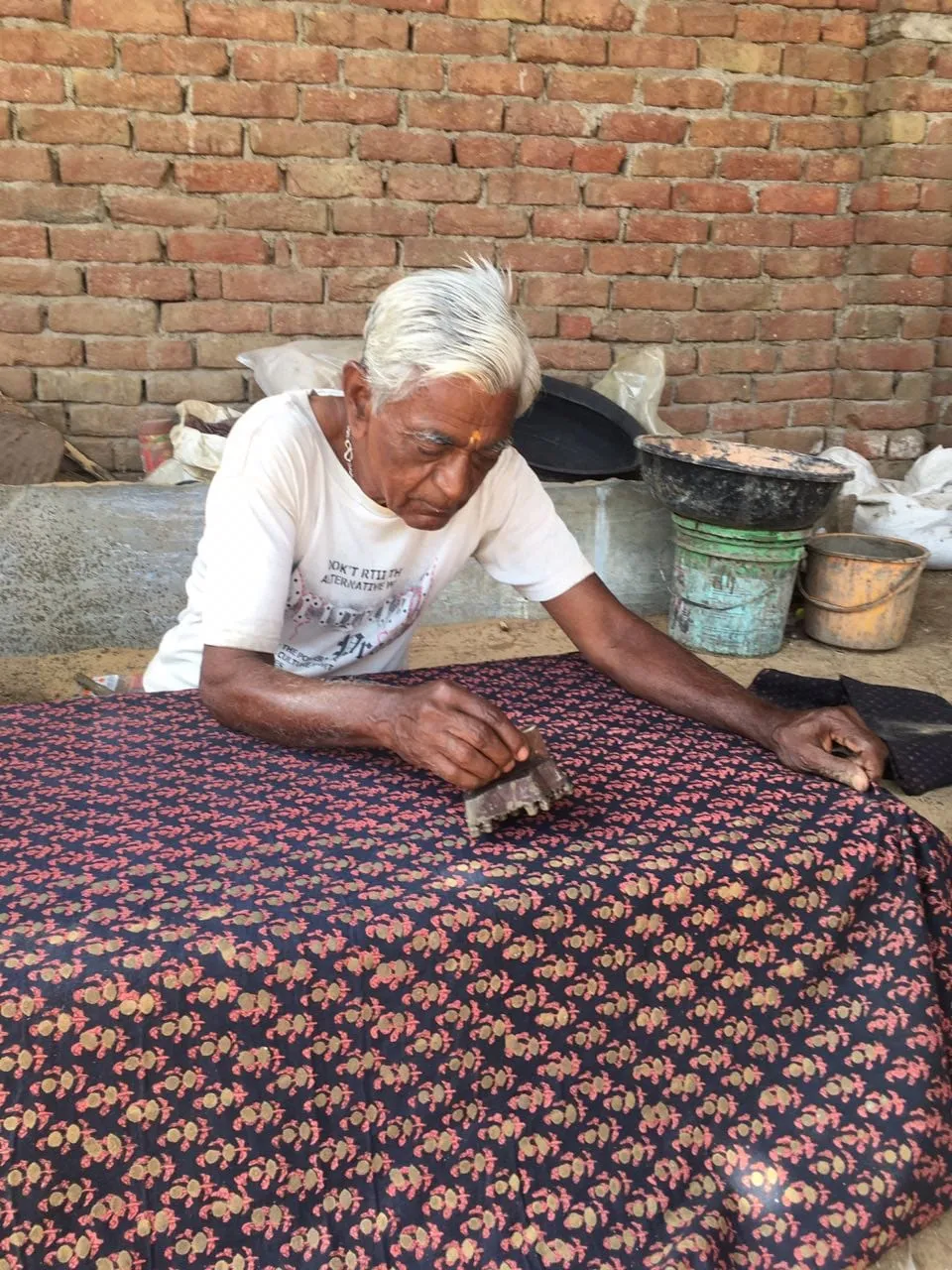
When Studio Bagru's co-founder first came to Bagru in 2009, cloth came to a printing family from a trader and went back out at seven rupees a metre, through eight sets of hands, to a customer who never learned who made it. The design, the skill and the name of the village all disappeared on the way.
Cloth that looks like Bagru's is now screen printed, far more cheaply, and sold on the strength of a look the printers of Bagru built. A study of the Bagru cluster records the printers' own account: to compete, some now print with synthetic pigments alongside natural dyes.
Sources: the letter from the co-founder; Block Printing in Bagru, Bagru Cluster, RUDA and Pearl Academy of Fashion, Jaipur, pp. 25 to 27.
The framework
Consent, Credit, Compensation.
Consent
Ask the artisan or the community before a design or a technique is used, and accept no for an answer.
Credit
Name the people and the place the work came from, on the label, in the catalogue and online, wherever it is sold.
Compensation
Pay the people whose work it is, every time it earns.
These are the three principles of the Cultural Intellectual Property Rights Initiative (CIPRI), founded by the lawyer Monica Boța-Moisin. Studio Bagru is a member, and wrote them into the contracts of Mahila Print.
What the law protects today
- 01
A Geographical Indication protects the name
Bagru Hand Block Print is a registered Geographical Indication in India, application 183. The registration names the area where it is made: Bagru, Kalakhera, Jahota and Jairampura. A GI protects the name of goods from a place. It does not, by itself, protect an individual design or the person who drew it.
- 02
A treaty for traditional knowledge, not for cloth
In May 2024 the World Intellectual Property Organization adopted its first treaty on traditional knowledge. It asks people applying for a patent to disclose where the genetic resources and the traditional knowledge behind an invention came from. It concerns patents, not patterns, and it comes into force once fifteen countries have joined.
- 03
Patterns and techniques are still being negotiated
Governments at WIPO have negotiated for years over how to protect traditional cultural expressions: the designs, motifs and techniques a community holds in common. The committee met for the 53rd time in September 2026, working on a single consolidated text. There is no treaty yet.
For a pattern a community holds in common, there is no international law yet. That is what the three principles are for.
What a buyer or a brand can do
Ask first
Before you adapt a traditional motif or a printer's design, ask the workshop. The index lists printers by name, and the buyer's guide explains how to brief one.
Credit in writing
Put the printer and the place on the label and the product page. Mahila Print's line is a good model: Name of the design, created by Name of the Artisan, year of development, ©Mahila Print.
Pay where the work is
Pay the workshop directly and on time. If a design is the printer's own, agree a fee or a royalty for using it, in writing.
Say no to look-alikes
A screen-printed copy of a hand-blocked pattern takes the look and leaves the people out. If it says Bagru, ask who printed it.