
The buyer’s guide
How to commission block printing in Bagru, directly.
What happens to a length of cloth in Bagru, who does each part, how to brief a printer, what a fair timeline and price look like, and what to expect from cloth made by hand. Everything learned since 2010 by standing in the middle, so that you no longer need anyone there.
- Designers developing a print for garments or home
- Brands and shops looking for yardage or finished products
- Hotels and hospitality commissioning robes, linen and amenities
- First-time buyers who want to do this well
How cloth moves through Bagru
The process
-
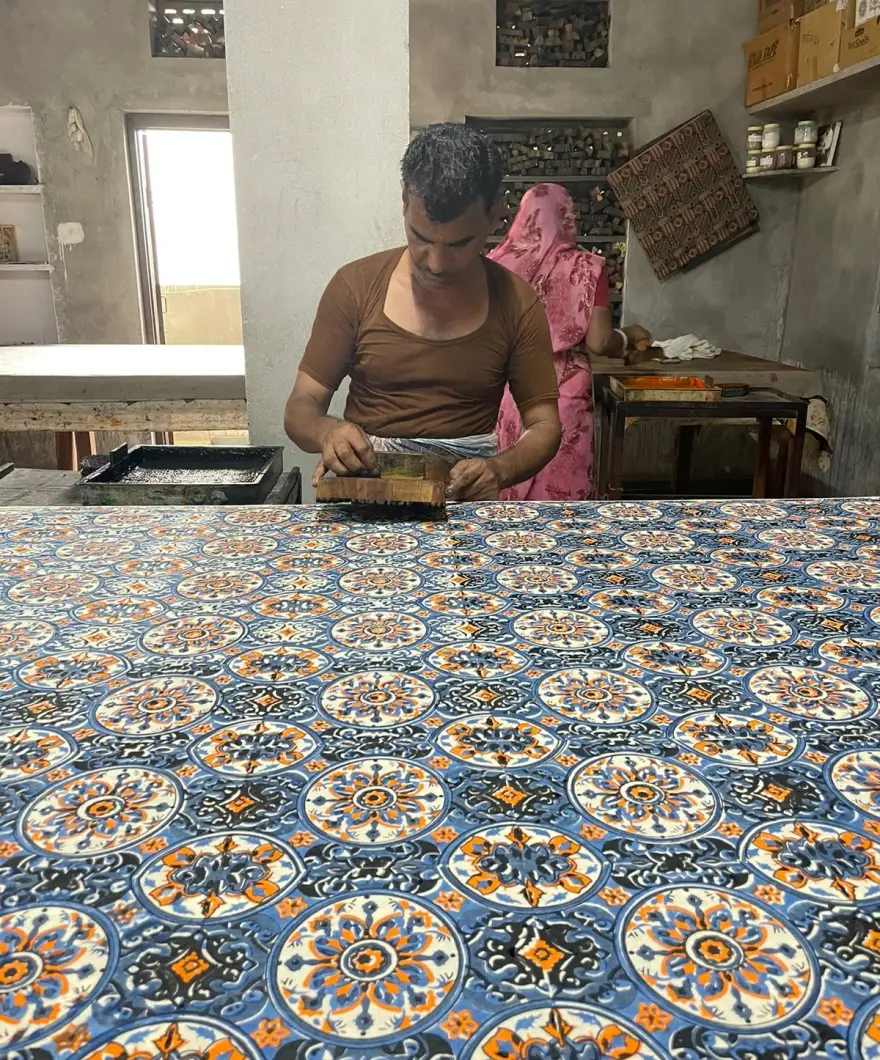
A block in hand at the printing table. Step 01
The block
Thappa
Every print begins as a set of blocks carved by hand into seasoned hardwood, usually sheesham or teak. A design is normally three blocks: the rekh, which prints the outline; the datta, which fills it; and the gadh, which prints the ground. A set takes three to six days to carve.
If you bring your own artwork, ask for a clean line drawing of one repeat, with the repeat size in centimetres. Fine lines carve well; very fine lines and large flat areas both misbehave when printed.
-
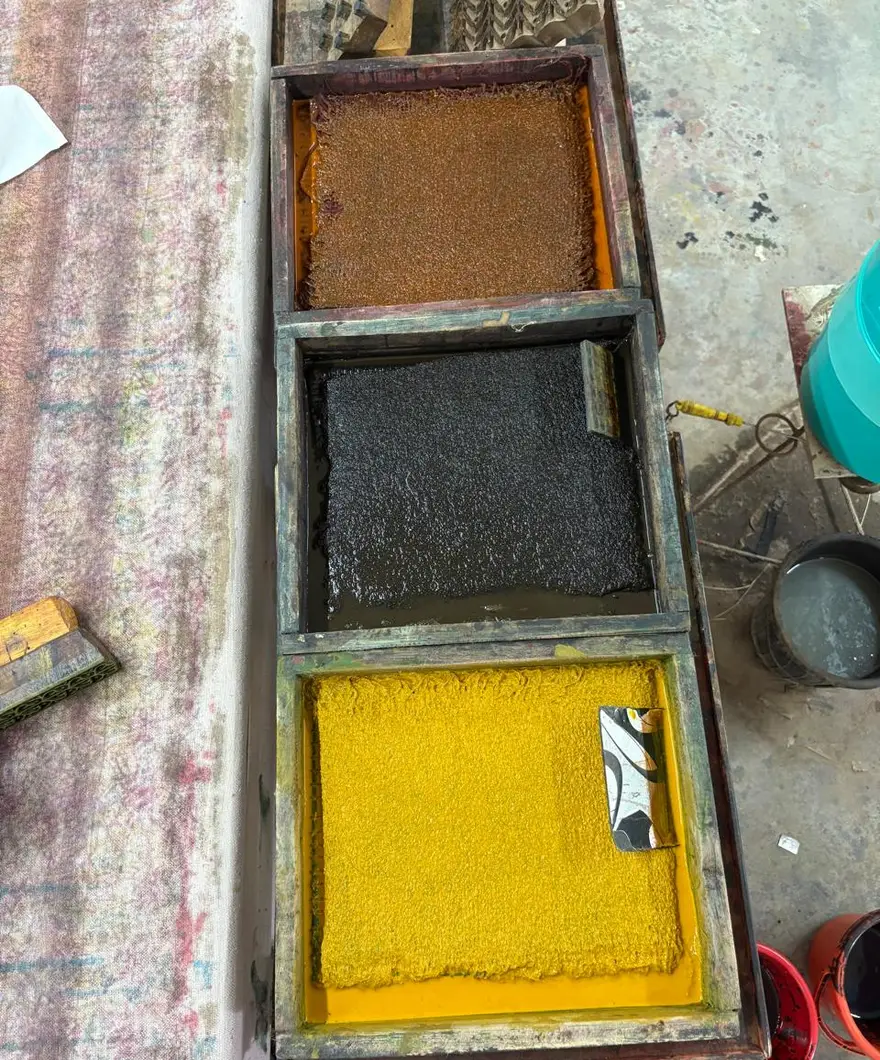
Trays of kashish brown, syahi black and harda yellow. Step 02
Preparing the cloth
Harda
Grey cloth is washed to remove starch and sizing, then steeped in harda, a solution of myrobalan fruit. The tannin turns the cloth a pale yellow. This is the Bagru ground you may know as “cream”: the tannin is what lets iron black and alum red bind.
Bagru cloth is usually cotton cambric or mulmul; linen and silk are possible but need a workshop that has printed them before.
-
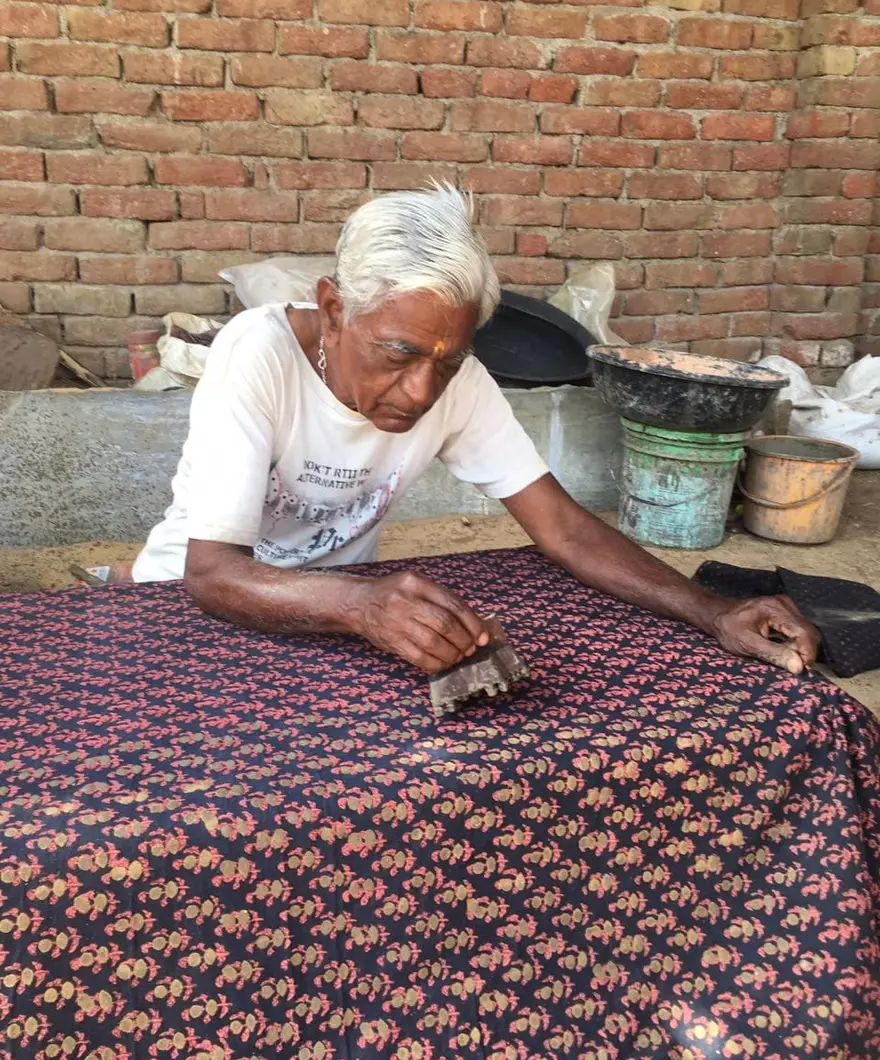
One impression at a time. Step 03
Printing
Chhapai
The printer works at a long padded table with the cloth pinned flat, dipping the block in a tray of colour and pressing it down with the heel of the hand, one impression at a time, aligning each to the last by eye. A simple one-block repeat runs thirty to thirty-five metres a day; a three-block design in three colours takes proportionally longer.
Two traditional colours are printed this way. Syahi is a black made by fermenting scrap iron with jaggery; it turns black on harda-treated cloth. Begar is an alum mordant printed with gum; after washing, the cloth is boiled with alizarin, and red develops only where the alum was printed.
Pigment printing uses ready-mixed, binder-based colours that are printed and cured without a dye bath. It is faster and more consistent, and it offers any colour you like. It lacks the depth of a dyed colour, because it sits on the cloth rather than in it.
-
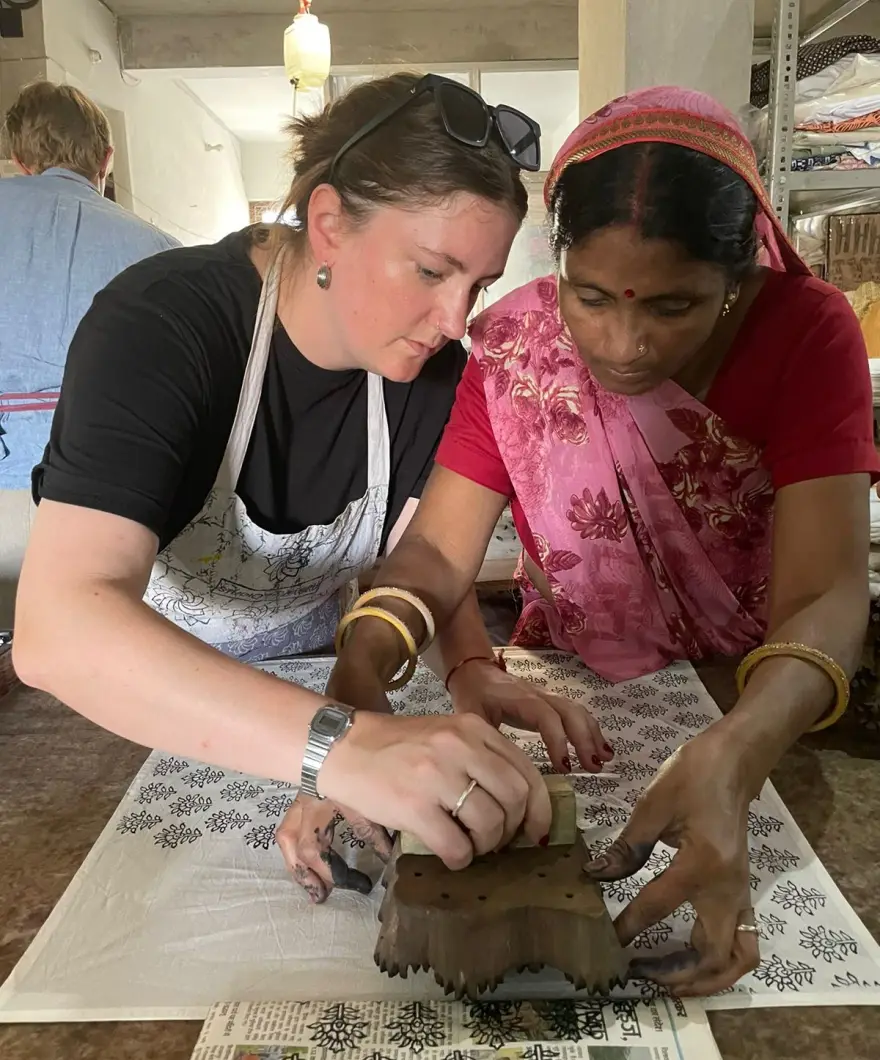
A multi-block design at the table. Step 04
Resist
Dabu
Dabu is a mud resist: black clay, gum, lime and wheat chaff, mixed to a paste, printed with the block and dusted with sawdust so it will not smudge. Where the mud sits, dye cannot reach. The cloth is dried, dyed, and washed, and the pattern appears in reverse, pale on colour.
Cracks in the dried mud let dye in, and the fine veining they leave is the signature of dabu. Ask for it or ask against it, but do not expect it to be identical from length to length.
-
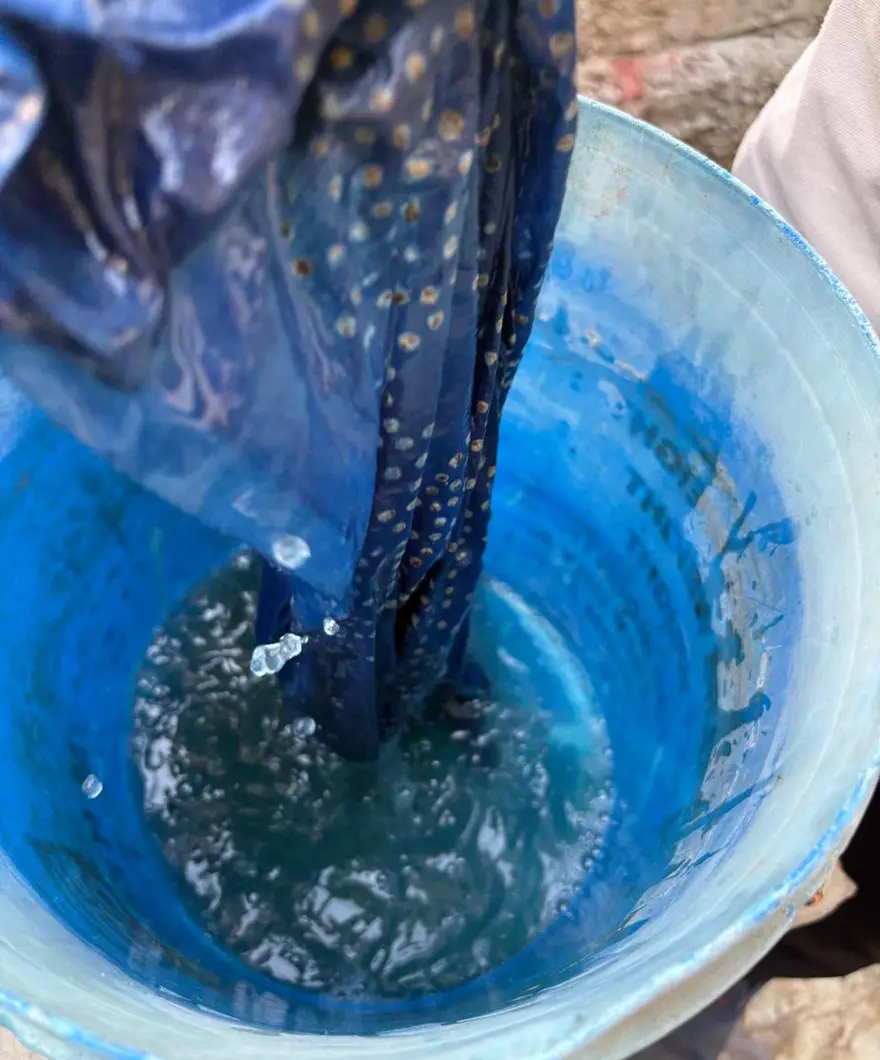
Lifting dabu-printed cloth from the vat. Step 05
Indigo
Neel
Natural indigo is fermented with lime and a reducing agent, which is why dyers speak of the vat as something alive: it has to be fed and rested. The cloth is dipped and lifted repeatedly, comes out yellow-green, and turns blue in the air. Each dip deepens the shade, so “how many dips” is the question to ask when you specify a blue.
Many workshops now keep a synthetic vat for consistency and a natural one for character. Ask which you are buying. Both are hand-dyed; only one is natural.
-
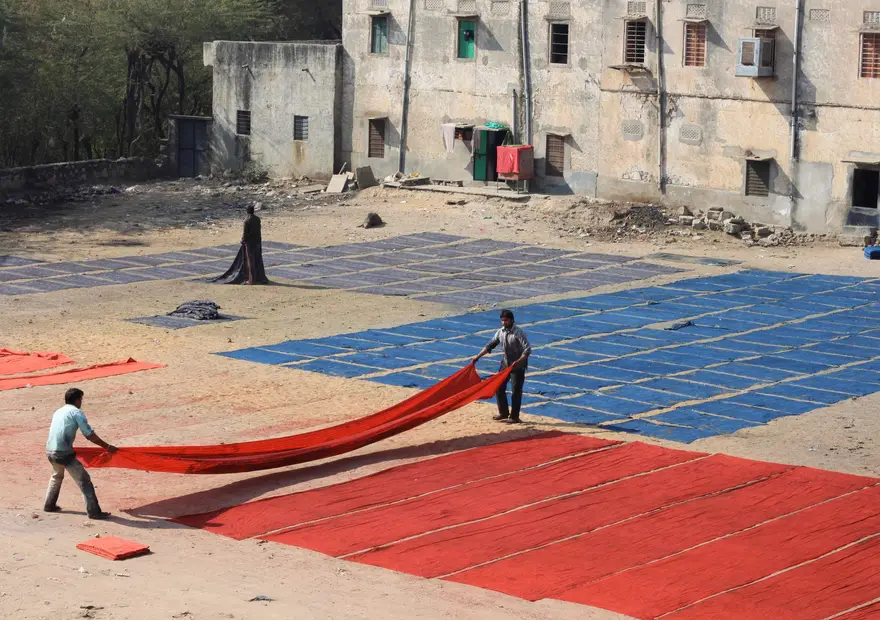
The Fields of Colour, Bagru. Step 06
Washing and the Fields of Colour
Dhulai
Printed cloth is washed in running water to clear the resist and fix the colour, boiled where red is being developed, then spread on open ground to dry in the sun. This is the sight Bagru is known for. It is also why natural-dye work slows in the monsoon: there is no sun to dry on.
Water and sunlight are part of the recipe. A quote that promises natural indigo in August is a quote to read twice.
-
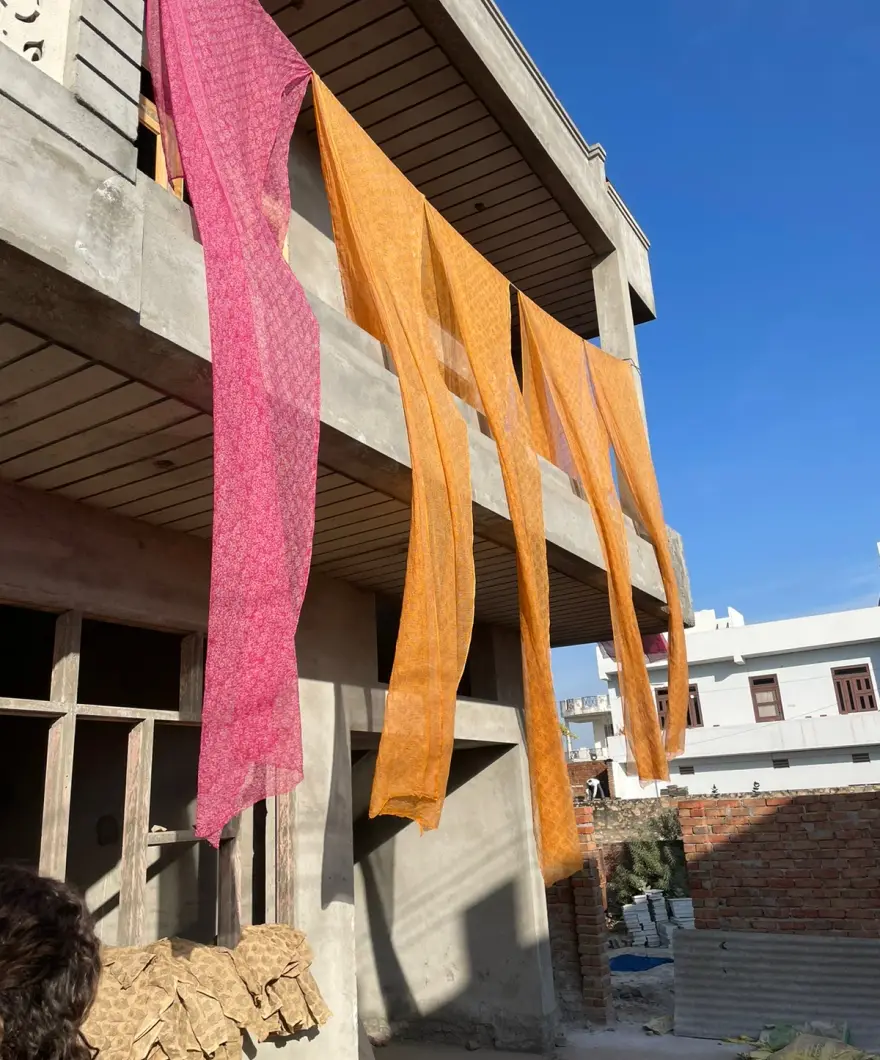
Printed scarves hung to dry. Step 07
Finishing
Silai
Dry cloth is calendered flat, checked, and either rolled as yardage or cut and stitched into product: totes, robes, cushion covers, table linen, quilts. Stitching may happen in the printing house or at a separate tailoring unit; ask which, because it changes the timeline and the price.
Labels, hang tags and packing are simple to add if you send the materials or the artwork early.
The trade
Who does what
-
Block carver
KharadiCarves the design into seasoned hardwood, usually sheesham or teak. A design is normally a set of blocks: the outline, the fill, and the ground. Three to six days for a set.
Ask: Whether they will carve from your artwork, what repeat size they can hold, and whether the blocks stay yours.
-
Printer
ChhipaPrints the cloth by hand at a long padded table, one impression at a time, aligning by eye. Thirty to thirty-five metres of a simple repeat in a day. In Bagru the surname and the verb are the same word.
Ask: Which techniques they print themselves (pigment, syahi-begar, dabu, indigo) and which they send out.
-
Dyer
RangrezRuns the vats and the boiling: indigo, alizarin for red, and the harda bath that prepares the cloth. Some printing houses dye in house; many send cloth to a dyer.
Ask: Whether the vat is natural or synthetic indigo, and how many dips a colour takes.
-
Washer
DhobiWashes the printed cloth to clear the resist and fix the colour, then spreads it to dry on the ground. The Fields of Colour are the washers’ work.
Ask: Nothing directly. This is inside the printer’s price.
-
Tailor and finisher
DarziCuts and stitches finished products: totes, robes, cushions, table linen. Calendering, labels and packing sit here too.
Ask: Whether the printer has a tailoring unit or you should source one. Sampling a stitched product adds weeks.
-
Exporter or courier
Moves the goods. A workshop with an Import Export Code can ship directly on a commercial invoice; without one, a courier or a merchant exporter does the paperwork.
Ask: Who is the exporter of record, and whether the quote is ex-works Bagru or delivered.
The brief
How to brief a printer
A good brief is one message the printer can forward to the carver, the dyer and the tailor without asking you anything. Send it as text with images attached, not as a PDF.
- The product
- What it will become: yardage for garments, robes, cushion covers, table linen. End use decides cloth weight and technique.
- The cloth
- Fibre and weight (cotton cambric, mulmul, linen, silk), and whether the workshop sources it or you send it. Most workshops prefer to source; it is cheaper and it arrives.
- The design
- A line drawing of one repeat with the repeat size in cm, or the name of an existing block you have seen. Say which blocks you want carved new and who owns them afterwards.
- The colours
- Pigment, syahi-begar, dabu, indigo, or a combination. Send a physical swatch or a Pantone reference, and say whether variation between lots is acceptable.
- The quantity
- In metres for yardage, in pieces for products, per design and per colourway. Minimums are usually 50 metres per design and colourway.
- The timeline
- When you need samples and when you need delivery, allowing for the seasons below. Say if a date is fixed (a launch, a season) or flexible.
- The budget
- A range, in rupees or dollars, per metre or per piece. It saves both sides a week of guessing.
- The extras
- Labels, tags, packing, photographs of the process, certificates of origin. Ask now, not after the cloth is packed.
Hello, I'd like to commission hand block printing in Bagru.

PRODUCT: 120 cushion covers, 50 × 50 cm, plus 60 m of matching yardage.
CLOTH: Cotton cambric, approx. 140 gsm. Please source.
DESIGN: Attached: one repeat, 12 × 12 cm, two colours. New blocks please; we will pay for carving and would like to keep the blocks.
COLOURS: Natural indigo (3 dips) on harda ground with syahi black outline. Lot-to-lot variation is fine within the attached range.
QUANTITY: 60 m yardage + 120 covers (approx. 70 m). One colourway.
TIMELINE: Strike-off by 20 Nov 2026; delivery by 28 Feb 2027 (fixed: spring launch).
BUDGET: USD 9–12 per metre printed and finished; USD 14–18 per finished cover.
EXTRAS: Woven labels (we send), process photos, signed note naming the printers.
SHIPPING: Door to door to Melbourne, Australia by courier. Please quote ex-works and delivered.

Could you send a proforma invoice for the strike-off and confirm the timeline? Thank you.
Terms
Minimums, timelines and prices
The figures Studio Bagru quoted for managed production, offered here as a reference. Working directly with a workshop can be quicker; it can also be slower if you are its only customer that month. Ask, and build in a margin.
| Service | Sampling | Production | Minimum |
|---|---|---|---|
| Pigment block printing | 6–8 weeks | 3–4 months | 50 metres per design and colourway |
| Block printing, natural dyes | 8–12 weeks | 4–6 months | 50 metres per design and colourway |
| Dabu resist and indigo | 10–12 weeks | 5–6 months | 50 metres per design and colourway |
| Finished products (totes, robes, linen) | 6–10 weeks | 3–6 months | 35–80 pieces, by product |
Prices
- Ask for a price per metre or per piece, and ask what it includes: base cloth, blocks, printing, washing, finishing, packing. A cheap print on cloth you still have to buy is not cheap.
- Pigment is the least expensive; natural dyes cost more because they take more days and more sun; dabu and multi-dip indigo cost the most because they take the longest.
- Custom block carving is a one-time cost on top. Agree in writing whether the blocks are yours to take or stay with the workshop.
- Quantities below the minimum are sampling, and are priced as sampling.
Payment
- 50% advance
- to begin production, after samples are approved.
- 50% before shipping
- after you approve photographs and the QC report.
Ask for a proforma invoice before you pay anything, and pay by bank transfer to the account named on it. Do not pay to a personal account you have not verified by a video call.
A workshop that exports directly needs an Import Export Code and will invoice you with its GST number. One that does not will ship through a courier or a merchant exporter, who becomes the exporter of record. Both are normal; know which you are dealing with.
The calendar
The seasons
Bagru prints outdoors. The calendar is part of the process.
- Best
October – February
Dry, sunny, cool. Every technique, including natural dyeing and indigo, runs at full pace. Book early; it is also the visitor season.
- Good
March – May
Hot and dry. Everything still runs, though heavy natural-dye work slows in the afternoon heat. Holi falls in March and the village stops for it.
- Monsoon
June – September
Humid, with rain. Pigment printing continues under cover; natural dyeing and indigo slow or stop for want of sun. Do not schedule a natural-dye delivery for September without a margin.
Diwali (October or November) closes workshops for a week or more. Sunday is usually a day off.
The material
What to expect from cloth made by hand
Handmade variation is not a defect. Here is what it looks like, so that you can specify it rather than be surprised by it.
- Registration
- Where blocks meet, the join can drift by a millimetre or two. Small motifs hide it; large geometric repeats show it. Design for it.
- Colour between lots
- Natural dyes shift with the water, the season and the age of the vat. Two lots of the same indigo will differ. Specify a range, or order the whole run at once.
- Shrinkage
- Cotton shrinks three to five per cent in the first wash. Pre-wash yardage before cutting garments, or ask the workshop to.
- Crocking
- Indigo rubs off at first, on hands and on light-coloured cloth beside it. It settles after a few washes. Warn your customers, or wash before you ship.
- Care
- Cold wash, mild detergent, no bleach, dry in shade. Natural dyes fade gently over years in direct sun; that is the material, not a fault.
- Imperfection
- A dropped impression, a blot at the selvedge, a slightly heavier hand on one line: each piece carries the maker’s hand. If you need machine uniformity, you need a machine.
Working together
Working with a workshop
Sourcing here works the way sourcing works anywhere: one thread, numbers that cannot be misread, an approved sample, and money that arrives when you said it would.
-
Keep one thread. Most workshops run the working day on WhatsApp, so photographs of blocks, strike-offs, drying cloth and packed cartons arrive there. One topic per message, and confirm each decision in the same thread, so the record sits in one place for both of you.
-
Write numbers so they cannot be misread: quantities as “50 m” not “fifty”, dates as “12 Nov 2026”, prices with the currency. Read back what you understood, and ask them to read back what they understood.
-
Ask for a strike-off, a printed sample of your design on your cloth, before the full run, and approve it in writing. That sample is the specification you both work to.
-
Set the calendar together. Ask which weeks the workshop is closed and how full its table is in the months you need, then fix the delivery date around the answer.
-
Agree payment terms in the first messages and pay on the day you said. Half to begin and half before shipping is the common shape; the advance is what buys your cloth and your dye.
-
Say what the cloth is for. A workshop that knows the piece is a summer dress rather than an upholstery panel will tell you which base cloth, which dye and which repeat will do the job better than the one you asked for.
-
Visit if you can. Bagru is thirty-two kilometres west of Jaipur on the Ajmer road, and a return taxi costs a little over two thousand rupees.
The vocabulary
Glossary
- Bagru
- A village 32 km west of Jaipur, Rajasthan, printing cloth by hand for at least four hundred years. Known for its cream harda ground, syahi black, begar red, dabu resist and indigo.
- Chhipa
- A printer; also the printers’ surname. In Bagru the word for the work and the word for the family are the same.
- Chhipa Mohalla
- The printers’ quarter of Bagru, where most printing houses are.
- Thappa
- A hand-carved wooden printing block.
- Rekh, datta, gadh
- The outline block, the fill block and the ground block that together print one design.
- Harda
- Myrobalan. A tannin bath that turns cloth pale yellow and lets iron black and alum red bind.
- Syahi
- Black, made from scrap iron fermented with jaggery.
- Begar
- Alum mordant printed with gum; boiled with alizarin, it becomes red.
- Dabu
- Mud resist: clay, gum, lime and wheat chaff, printed then dusted with sawdust.
- Neel
- Indigo. A natural vat is fermented; the cloth turns blue in the air after each dip.
- Kashish
- Ferrous sulphate, giving greys and browns.
- Bhuti
- A small single motif, printed in scattered repeat. The Studio Bagru mark is a bhuti.
- Jaal
- An all-over trellis or net pattern.
- Bel
- A border vine.
- Mulmul
- Fine, soft cotton muslin.
- Cambric
- A light, closely woven cotton; the usual cloth for Bagru yardage.
- Strike-off
- A printed sample of your design on your cloth, approved before the full run.
- MOQ
- Minimum order quantity. In Bagru, usually 50 metres per design and colourway.
- IEC
- Import Export Code. An Indian business needs one to export directly.
Questions buyers ask
Questions
Can I order less than fifty metres?
Sometimes, at sampling prices. A workshop may print a short length of an existing block for you at a per-metre rate well above production pricing, because setting up the table and the colours costs the same however long the run. For custom blocks, expect the carving cost regardless of length.
Who owns a custom block?
Whoever you agree owns it. The default in Bagru is that the block stays with the workshop that carved and printed it. If exclusivity matters to you, pay for the block, say in writing that the design is yours, and take the blocks with you at the end of the order.
How do I know a print is natural dye and not pigment?
Ask, and look at the back. Pigment sits on the surface and the reverse is much paler; dyed cloth is coloured through, so the back is nearly as strong as the front. Natural indigo also rubs off on a white cloth at first; pigment does not.
Can one workshop combine printing with embroidery or weaving?
Printing houses print. Embroidery, dhurrie weaving and stitching are separate trades, sometimes in the same family and often not. A good printer will tell you who they send work to; ask to deal with that unit directly for anything that is not printing.
Can I visit while my order is being made?
Usually, and you should. Arrange it in advance, expect to be fed, and bring photographs of the end product so that the family can see where their cloth goes. Bagru is under an hour from Jaipur.
Will I get a certificate of authenticity?
Ask for a signed note from the workshop naming the printers, the techniques, and the origin of the cloth and dyes. It is a statement from the maker rather than a formal certification scheme, and worth more for it.
How do I ship it home?
Under about thirty kilograms, an international courier (DHL, FedEx, UPS) collects from Jaipur and delivers door to door in a week; the workshop or its courier agent prepares the commercial invoice. Larger lots go by air freight through a forwarder. Sea freight is rarely worth it below a few hundred kilograms. Duties are yours to pay on arrival; check your country’s rate for printed cotton before you order.
What about labour and fair pay?
Most Bagru printing houses are families working in their own homes; a large one employs a few printers from other families. Ask who prints your cloth and how they are paid. Prompt payment on your side is the single most effective thing you can do for fair pay on theirs.