

History
The Repeating Hand: A History of Block Printing
- 17.5 cmheight of the steatite Priest-King
- 6th millennium BCEcotton fibres in a grave at Mehrgarh
- 868the oldest dated printed book, carved on woodblocks
- 14th centuryearliest evidence of block-printed textiles in Europe
Where it happened
22 placesChoose a point to see what happened there.
Boundaries: Natural Earth, India’s point of view (public domain). A point marks where the sources place an event; some places are approximate.
Cotton & clay
from 6000 BCECotton, spinning and the Indus cloak. Opens with the Mehrgarh fibres (6th millennium BCE).
-
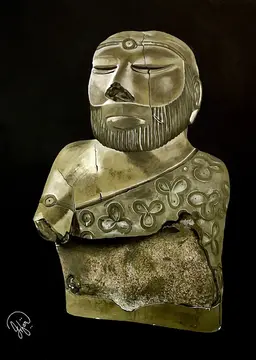
The Priest-King, photograph. Irfanmurtaza, CC BY-SA 4.0, via Wikimedia Commons -
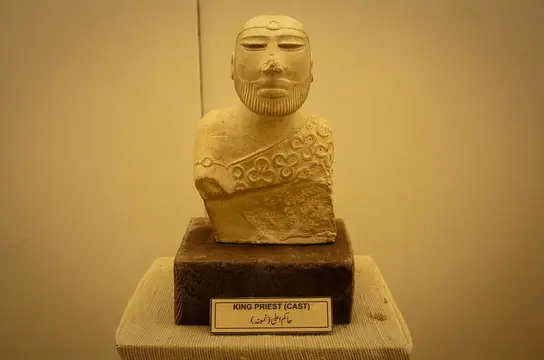
The Priest-King, a cast with its museum label. Umair Shaikh Shaikh, CC BY-SA 2.0, via Wikimedia Commons -
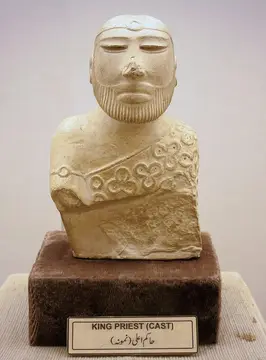
The Priest-King, a cast with its museum label. Umair Shaikh Shaikh, CC BY 2.5, via Wikimedia Commons -
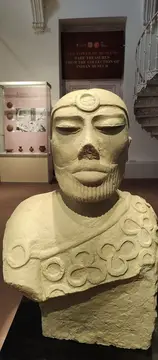
Replica of the Priest-King, shown in a Kolkata museum. Ganesh Mohan T, CC BY-SA 4.0, via Wikimedia Commons
Cotton fibres in a Neolithic grave at Mehrgarh
Threads preserved by mineralization in a copper bead from a Neolithic burial at Mehrgarh were analysed and identified as cotton (genus Gossypium). The authors could not say whether the cotton came from a domesticated species, but wrote that cotton was already known and exploited for its fibres at this period.1
Cotton, the fibre every later Indus textile and every block-printed cloth in this story depends on, was in use in the Indus region more than 3,000 years before the Priest-King.
The earliest textile evidence at Harappa
Excavations at Harappa recovered woven-textile impressions on terracotta beads and spindle whorls from the site's earliest occupations. Harappa.com dates the earliest evidence of textiles there to about 3300 BCE.2 3
Spinning and weaving are secure in the Indus world long before the carved cloak of the Priest-King.
The Priest-King's carved cloak
A steatite bust, 17.5 cm high, found at Mohenjo-daro and now in the National Museum, Karachi. Its left shoulder is covered with a cloak decorated with trefoil, double circle and single circle designs that were originally filled with red pigment, cut with a specialized drill and touched up with a chisel. The carving shows a pattern on a garment; it does not show how that pattern was made on cloth. Harappa.com itself puts the name 'Priest King' in quotation marks.4 3
The oldest image of a patterned cloth in this story, and the reason for the question the page asks: could such a pattern have been printed?
A scrap of cotton from Mohenjo-daro, reported dyed with madder
John Marshall's excavators found a small piece of woven material on the lid of a silver case, preserved by silver salts. The Technological Research laboratory in Bombay found the convoluted structure characteristic of cotton and called its results 'tentative'. The Ashmolean Museum notes that a cotton fragment from Mohenjo-daro, carbon-dated to 1760 BCE ±115, 'has been reported to show evidence of madder dyeing', which would imply knowledge of mordants. Two cautions: the lab report was preliminary, and 1760 BCE is later than the urban Harappa period.5 6
The only reported hint of mordant dyeing in the Indus world. It makes a red, printed cloak possible, not shown.
First prints
from 200 BCEPrinting on silk in Han China. Opens at 200 BCE, an editorial boundary.
Printed and painted silk gauze in a Han tomb at Mawangdui
Tomb 1 at Mawangdui yielded a robe of printed and painted gauze. Search summaries of the Hunan Museum's and the Metropolitan Museum's pages say the Han printing was done with a stencil or stamp and then hand-coloured, which is not the same as printing with a carved block. This study has not been able to read either page (the Hunan Museum page timed out and the Met's site returned HTTP 429), so this entry is PENDING and makes no claim about how the cloth was printed.7 8
Printing on cloth in China is far older than printing on paper; the exact method at Mawangdui is still to be checked.
Silk, sutras & the Nile
from 600The Diamond Sutra, carved blocks in Egypt, Gujarat's cottons reach the Nile. Opens at 600 CE, an editorial boundary.
-
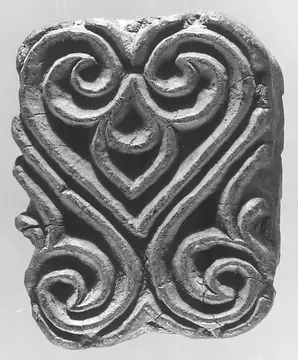
Carved wooden textile printing block, Egypt. The Metropolitan Museum of Art, Purchase, Mr. and Mrs. Bruce J. Westcott Gift, 1971 (CC0)
The Diamond Sutra: the oldest dated printed book
A Buddhist text was carved onto woodblocks and printed as a long scroll, with the date 11 May 868. It is printed on paper, not cloth: the best-dated early product of block printing is a book, and this study found no source that settles whether printing on textiles came first.9 10
Shows the carved-block principle fully developed by the 9th century, in China.
A carved wooden textile printing block from Egypt
The Met holds a carved wooden block catalogued as a textile printing block of the 10th century, from Egypt. It is the tool itself, not a print: a real carved block, a thousand years old.11
What a printing block looks like, and the earliest dated one in the Met's open collection.
Gujarati indigo-resist cottons reach Egypt
The Ashmolean Museum's Newberry collection holds Indian block-printed, resist- and mordant-dyed cottons found in Egypt. Radiocarbon tests in 1994-95 gave dates as early as 1010 CE (plus or minus 55 years), and every blue textile analysed showed traces of indigotin. Designs link the cloths to Gujarat, and 53 Indian textiles were excavated at the Red Sea port of Quseir al-Qadim.12
Physical evidence of Indian indigo-dyed cotton traded to the Islamic Mediterranean from the early 11th century.
Indian Ocean cloth
from 1200Quseir and Fustat, blocks from India, Europe learns late. Opens at 1200 CE, an editorial boundary.
-
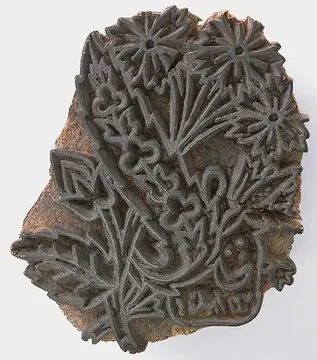
Carved wooden printing block, India. The Metropolitan Museum of Art, Purchase, V. Everit Macy Gift, 1930 (CC0) -
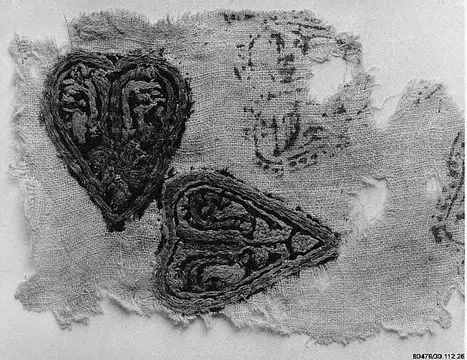
Block-printed and embroidered linen, Egypt. The Metropolitan Museum of Art, Purchase, V. Everit Macy Gift, 1930 (CC0) -
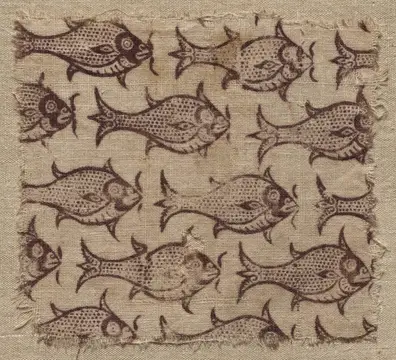
Fragment, block printing on plain weave. The Cleveland Museum of Art, Purchase from the J. H. Wade Fund (CC0) -
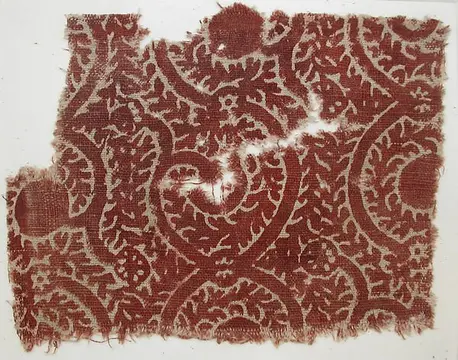
Block-printed cotton, found in Egypt. The Metropolitan Museum of Art, Purchase, V. Everit Macy Gift, 1930 (CC0) -
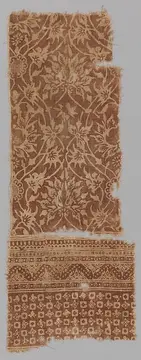
Textile with lotus and arabesque design. The Metropolitan Museum of Art, Purchase, V. Everit Macy Gift, 1930 (CC0) -
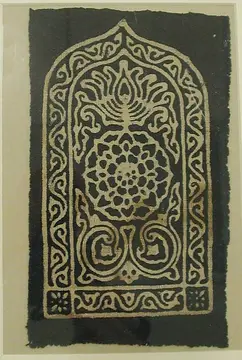
Stamp-resist-dyed cotton, probably Ahmadabad. The Metropolitan Museum of Art, Gift of Nelly, Violet and Elie Abemayor, in memory of Michel Abemayor, 1978 (CC0)
Block-printed cottons from India found in Egypt
At Quseir al-Qadim, a Red Sea port, 68 cotton fragments were found that match the 'Fustat' textiles identified as Gujarati: resist- and mordant-dyed cottons, mostly block-printed, dyed with indigotin and/or a red colorant from madder or morinda roots. The Quseir find was the first of its kind from a site excavated under datable conditions. Cleveland's catalogue dates a block-printed cotton fragment from Mamluk Egypt to the 1200s–1300s.6 13
The first secure datable proof that block-printed, mordant-dyed Indian cloth was traded across the Indian Ocean.
Block printing reaches Europe, late
The V&A: block printing of textiles 'seems to have come to Europe comparatively late, as there is no evidence that it was practised there earlier than the 14th century'. It may have been introduced into Italy first, then spread into Germany. The museum also notes that little is known about printing or the makers of printed textiles in the 14th century. The marker is approximate.14 15
Europe learned block printing about a thousand years after the Indian Ocean and China had it, which is why the Asian imports of the 17th century were such a shock.
A Gujarat cotton with trefoils, found in Cairo
The V&A's fragment IS.73-1972 is printed, mordant and resist-dyed cotton, made in India (Gujarat, probably) in the 15th century and found in Cairo. Its pattern 'consists of geometrical shapes, each filled with a variety of smaller patterns including trefoils', in red and white on an indigo ground.16
Trefoils, madder red and indigo on one printed cotton: the closest later echo of the Priest-King's motif that this study has found. A resemblance across 3,000 years is not a lineage.
A carved printing block from India
The Met's carved wooden printing block from India, 15th–16th century, shows the tool behind the Gujarati cottons that reached Egypt. The Met records it only as 'India', so the marker on the map is approximate.17
The Indian side of the same tradition as the Egyptian block, in wood, carved.
Chintz & calico
from 1600Indian cottons in Europe, bans, a European industry. Opens at 1600 CE, an editorial boundary.
-
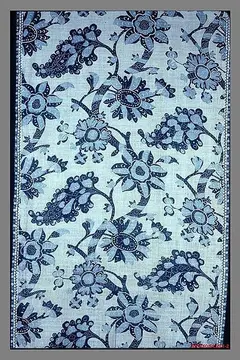
Bed hanging, blue-resist textile. The Metropolitan Museum of Art, Gift of Mrs. Reginald P. Rose and Franklin Benkard, 1954 (CC0) -
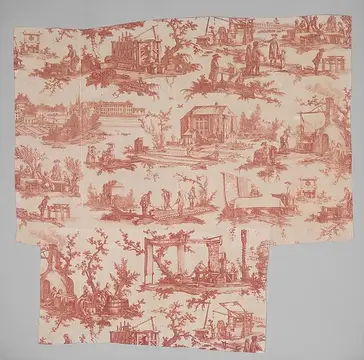
'Les Travaux de la Manufacture' (Jouy). The Metropolitan Museum of Art, Rogers Fund, 1926 (CC0)
Indian imports start European calico printing
A V&A printed calico of 1690–1700, probably made in England or the Netherlands, comes with this account: Indian painted textiles imported by the Dutch, English and French East India Companies gave a direct incentive to make satisfactory substitutes at home, and this led to the development of European calico printing industries. Giorgio Riello adds that Europeans found it hard to replicate mordant-based printing and dyeing.18 19
The moment the craft this site follows crosses into industry.
France lifts its ban on printed cottons
Riello writes that calico printing spread from Basle to Mulhouse and Neuchâtel and 'from there back to France after the ban was lifted in 1759'. This study did not find the 1686 French ban's own text, so the start of the prohibition is not stated here.19
Prohibitions, not demand, set the pace of European calico printing.
A printshop at Jouy-en-Josas
Riello cites a printed vignette of a printshop in Jouy-en-Josas belonging to the calico printer Oberkampf in the early 1780s. The Met holds the printed cloth 'Les Travaux de la Manufacture', dated 1783: a textile that shows the works that made it.19 20
A rare picture of block printing at work, printed on the cloth.
Mill & revival
from 1784Industrial printing, and the hand block kept by choice. Opens at 1784, an editorial boundary.
-
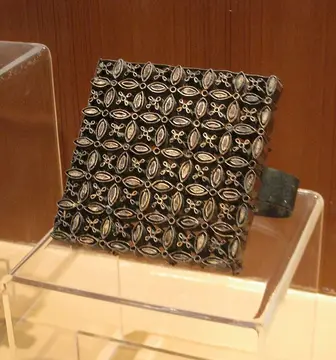
Applying a copper batik stamp (cap). Gunawan Kartapranata, CC BY-SA 3.0, via Wikimedia Commons -
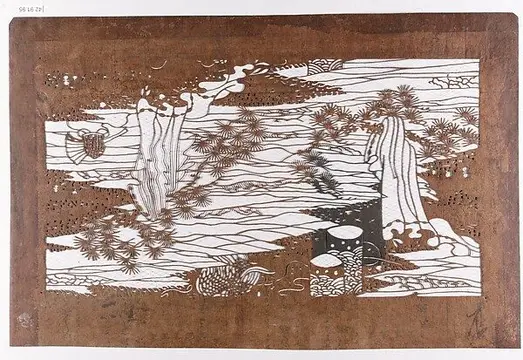
Japanese paper stencil (a stencil, not a block). The Metropolitan Museum of Art, Gift of Mrs. Horace Havemeyer, 1942 (CC0) -
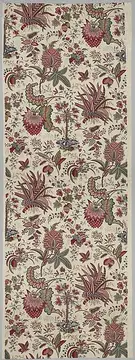
Block-printed cotton, 'Fleurs Tropicales et Palmiers'. The Metropolitan Museum of Art, Rogers Fund, 1937 (CC0) -
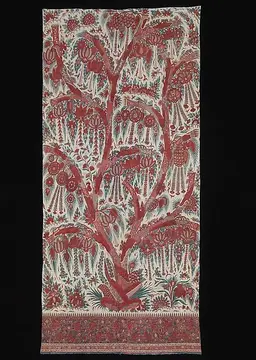
Palampore, mordant-painted cotton. The Metropolitan Museum of Art, Rogers Fund, 1928 (CC0) -
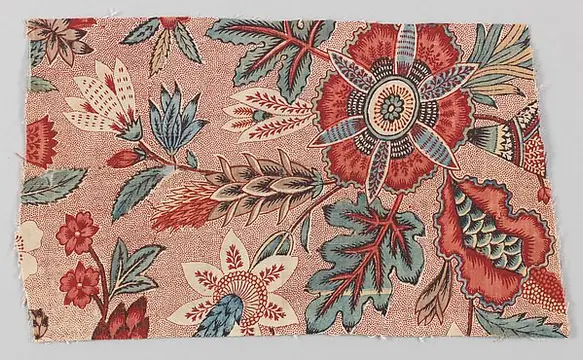
Block-printed cotton fragment. The Metropolitan Museum of Art, Gift of Titi Halle, 2010 (CC0) -
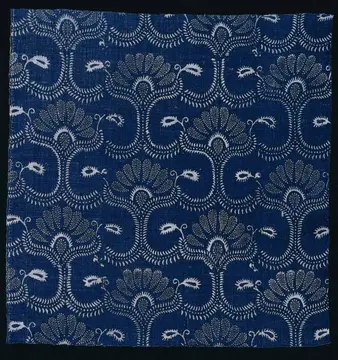
Loom width with stylized leaf design. Cleveland Museum of Art, Gift of Gertrude Underhill (CC0) -
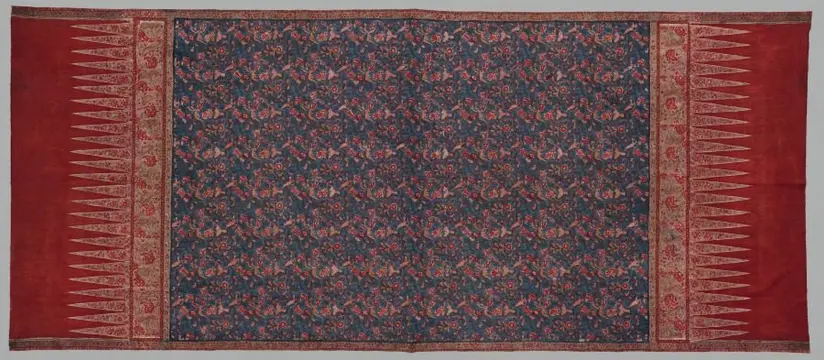
Hip wrapper (tapis), block printed. The Cleveland Museum of Art, John L. Severance Fund (CC0) -
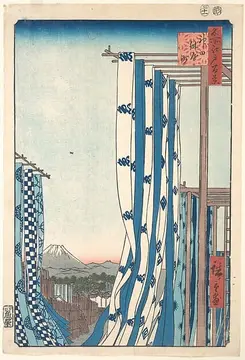
Dye House at Konya-chō, Kanda. Utagawa Hiroshige / The Metropolitan Museum of Art, The Howard Mansfield Collection, Purchase, Rogers Fund, 1936 (CC0)
Stamped adinkra cloth reaches the British Museum
A British Art Studies article describes adinkra as a stamped textile, made of cotton woven in long strips and decorated with repeated patterns in a grid. Thomas Bowdich acquired objects including stamped adinkra cloth on an 1816–18 mission centred on an 1817 journey to Kumase, and presented them to the British Museum in 1818 (formally added in 1831).21
Block-style stamping developed independently of the Indian and Chinese traditions, in West Africa.
Morris revives indigo discharge and the hand block
William Morris designed 'Strawberry Thief' in 1883 (V&A) and printed it with the indigo discharge method, 'an ancient technique used for many centuries mostly in Asia'. Cleveland's record says the process required the entire cloth to be dyed blue before it was bleached and block printed.22 23
Block printing survives industrialisation as a deliberate craft, borrowing from Asia.
Yoruba adire: from Abeokuta tie-dye to hand-painted adire eleko
Adire, indigo resist-dyed cloth made by Yoruba women, first appeared as a distinct type in Abeokuta. Adire eleko, with designs painted in cassava starch before dyeing, is dated to no earlier than about 1910 and grew popular in the 1920s on imported European cotton shirting. Ibadan became the centre for hand-painted cloths. Popular designs included Olokun ('goddess of the sea') and the Jubilee pattern made for George V's 1935 jubilee. Buyers came from Nigeria, the Gold Coast, Senegal and the Belgian Congo.24 25 26 27
Shows a women-run indigo industry built on imported cloth and credit that sold across West and Central Africa.
Heritage today
from 1951Living resist and block traditions, listed as heritage. Opens at 1951, an editorial boundary.
-
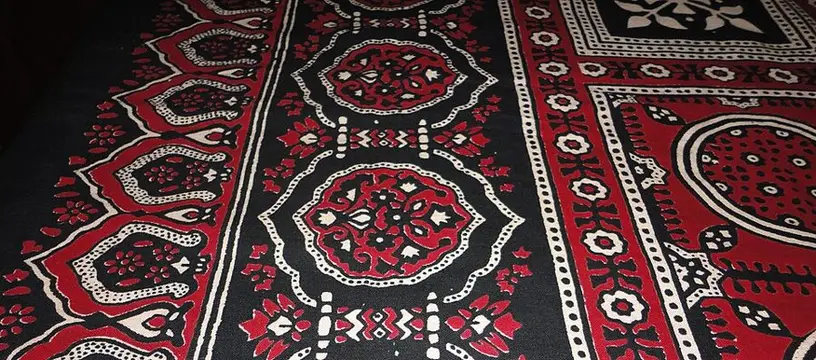
Ajrak. Ahub1988, CC BY-SA 3.0, via Wikimedia Commons -

Indigo vat, Blaudruckerei Wagner. Geolina163 / Wikimedia Commons (CC BY-SA 4.0)
Nantong blue calico listed as national intangible heritage
Nantong was a cotton-textile centre in the Ming (1368-1644) and Qing (1644-1911) dynasties, when its resist-printed blue calico sold across China. Local records list 19 registered hand-dyeing workshops. The dye comes from fermented indigo plants. The printing and dyeing technique was listed as national intangible cultural heritage in 2006.28
A surviving Chinese vat-indigo tradition, now protected as heritage.
Miao batik of Danzhai granted national heritage status
Miao women in Danzhai make batik with beeswax and indigo. The craft received national heritage status in 2006. The provincial government reported in 2024 that more than 200 Miao women from nearby villages benefited and that annual sales had reached 8 million yuan (about USD 1.1 million).29
Indigo resist-dyeing reframed as heritage and rural-income policy.
UNESCO inscribes Indonesian batik
UNESCO added Indonesian batik to the Representative List of the Intangible Cultural Heritage of Humanity in 2009. It describes batik as hot-wax resist patterning dyed with 'vegetable and other dyes'; the listing does not name indigo. Museum accounts note that a deep indigo blue could take as many as sixty dye baths, and that chemical dyes arrived in the late 1800s.30 31
International heritage status for Southeast Asia's main resist-dye tradition, in which indigo was the traditional blue.
UNESCO lists European indigo resist printing (Blaudruck)
At its 13th session (Port Louis, 26 Nov – 1 Dec 2018), UNESCO's intangible-heritage committee inscribed 'Blaudruck/Modrotisk/Kékfestés/Modrotlač, resist block printing and indigo dyeing in Europe' on the Representative List. The practice uses hand-carved blocks, some up to 300 years old, to print a dye-resistant paste on cloth before indigo dyeing. Today it survives mainly in small family workshops.32
International recognition of a surviving pre-industrial indigo craft in Central Europe.
Sources
- Harappa.com, First evidence of cotton at Neolithic Mehrgarh, Pakistan (abstract and commentary)
- Harappa.com, Harappan Textiles
- tDAR (the Digital Archaeological Record): abstract of a paper on Harappan textiles, Plant based textiles and basketry at Harappa, Pakistan (3700-1900 BCE)
- Harappa.com, Around the Indus in 90 Slides, "Priest King," Mohenjo-daro
- Harappa.com, quoting John Marshall (1931), In quest of a piece of cotton unearthed from Mohenjo Daro
- Ashmolean Museum, Eastern Art Online (Yousef Jameel Centre for Islamic and Asian Art), Indian textiles (Newberry collection essay)
- Hunan Museum, Printed and painted floss silk padded gauze robe
- The Metropolitan Museum of Art, Western Han printed silk (collection record 696723)
- Linda Hall Library, Scientist of the Day: The Diamond Sutra
- Smithsonian Magazine, Five things to know about the Diamond Sutra, the world's oldest dated printed book
- The Metropolitan Museum of Art, Textile Printing Block (accession 1971.87)
- Ashmolean Museum, University of Oxford (Yousef Jameel Centre, Eastern Art Online), Indian Block-Printed Textiles in Egypt: The Newberry Collection (Ruth Barnes)
- The Cleveland Museum of Art, Fragment (accession 1929.845)
- Victoria and Albert Museum, Block printed linen with pattern of birds (7022-1860)
- Victoria and Albert Museum, Printed linen fragment (1745-1888)
- Victoria and Albert Museum, Fragment IS.73-1972
- The Metropolitan Museum of Art, Printing Block (accession 30.112.13)
- Victoria and Albert Museum, Printed cotton, calico (12-1884)
- London School of Economics, Global Economic History Network (working paper by Giorgio Riello), The Rise of Calico Printing in Europe and the Influence of Asia in the Seventeenth and Eighteenth Centuries
- The Metropolitan Museum of Art, "Les Travaux de la Manufacture" (accession 26.233.8)
- British Art Studies (Yale Center for British Art and Paul Mellon Centre), issue 28, Adinkra from Kumase to the British Museum
- Victoria and Albert Museum, 'Strawberry Thief' (T.586-1919)
- The Cleveland Museum of Art, Strawberry Thief (accession 1937.696)
- Horniman Museum and Gardens, Nigeria60: Adire Archives (Amanda Kirby Okoye)
- Victoria and Albert Museum, Àdìrẹ: tied and dyed indigo textiles
- Cambridge University Press (Journal of African History 38:1, pp. 77-99), Judith Byfield, 'Innovation and Conflict: Cloth Dyers and the Interwar Depression in Abeokuta, Nigeria'
- Adire African Textiles (Duncan Clarke, dealer/scholar website), Adire Cloth of the Yorubas
- Nantong Municipal People's Government (English portal), Nantong blue calico printing and dyeing craft
- Guizhou Provincial Government (eGuizhou English portal), Miao women making a better living with batik
- UNESCO Intangible Cultural Heritage, Indonesian Batik (inscribed 2009, 4.COM)
- Asian Art Museum of San Francisco, Batik: Spectacular Textiles of Java (exhibition, 2012-13)
- UNESCO Intangible Cultural Heritage, Blaudruck/Modrotisk/Kékfestés/Modrotlač, resist block printing and indigo dyeing in Europe
Open data
This history is free to read and reuse under CC BY 4.0. The quotes behind each source, the pictures' rights records and the data are kept with the study.